Consolidating Student Loans in 2026: Lower Payments Guide

Student loan consolidation in 2026 provides a crucial opportunity for borrowers to simplify their repayment process and potentially decrease monthly obligations by 10-15% through a single, more manageable loan.
As we navigate the complexities of personal finance in 2026, understanding your options for managing student debt is more critical than ever. For many, the idea of juggling multiple lenders, varying interest rates, and diverse payment due dates can be overwhelming. This is where student loan consolidation in 2026 emerges as a powerful tool, offering a practical solution to potentially lower your monthly payments by a significant 10-15%.
Understanding Student Loan Consolidation in 2026
Student loan consolidation is a financial strategy designed to simplify your student debt by combining multiple federal or private student loans into a single new loan. This process can offer a fresh start, often with a new interest rate and a single monthly payment, making your financial life significantly easier to manage. In 2026, the landscape of student lending and repayment continues to evolve, making it essential to understand the current mechanisms and benefits.
The primary appeal of consolidation lies in its ability to streamline your finances. Instead of tracking several loans, you’ll have one lender, one interest rate, and one payment date. This simplification can reduce the likelihood of missed payments and the associated fees, improving your credit standing over time. Furthermore, consolidation can sometimes unlock more favorable repayment terms, especially for those with a strong credit history or federal loans eligible for specific programs.
Federal vs. Private Loan Consolidation
It’s crucial to distinguish between federal and private loan consolidation, as their structures and benefits differ significantly. Federal loan consolidation, primarily through a Direct Consolidation Loan, combines multiple federal education loans into a new federal loan. This process typically adjusts your interest rate to a weighted average of your previous loans, rounded up to the nearest one-eighth of a percentage point. Crucially, federal consolidation can also make you eligible for income-driven repayment plans and public service loan forgiveness programs, which private consolidation does not offer.
- Federal Loan Consolidation: Combines federal loans, retains federal benefits like income-driven repayment and forgiveness programs, and uses a weighted average interest rate.
- Private Loan Consolidation/Refinancing: Combines federal and/or private loans into a new private loan, often seeking a lower interest rate based on creditworthiness, but sacrifices federal benefits.
Private loan consolidation, often referred to as refinancing, involves taking out a new loan from a private lender to pay off existing federal and/or private student loans. This option is particularly attractive for borrowers with excellent credit who are looking to secure a lower interest rate than their current loans or consolidate private loans that don’t qualify for federal programs. However, a significant drawback of private consolidation is the forfeiture of federal loan benefits, such as income-driven repayment options, deferment, forbearance, and loan forgiveness programs. This trade-off must be carefully weighed against the potential for lower interest rates and reduced monthly payments.
In conclusion, understanding the type of loans you hold and the specific goals you aim to achieve through consolidation is the first critical step. Whether you opt for federal or private consolidation, the objective remains the same: to simplify your debt and make it more manageable in the long run.
Evaluating Your Current Loan Situation
Before embarking on the consolidation journey, a thorough evaluation of your existing student loan portfolio is paramount. This step involves gathering all relevant information about your loans, including the principal balance, interest rates, loan types (federal or private), remaining repayment terms, and current monthly payments. Having a clear and comprehensive picture of your current debt will enable you to make informed decisions about whether consolidation is the right path for you in 2026.
Start by compiling a list of all your student loans. This might require accessing your loan servicer accounts, checking your credit report, or reviewing old loan documents. Pay close attention to the interest rates associated with each loan. Loans with higher interest rates are often prime candidates for consolidation, especially if you can secure a new loan with a lower overall rate. Also, note the repayment terms; some loans might have shorter terms leading to higher monthly payments, which consolidation could extend to reduce the burden.
Key Loan Details to Consider
When reviewing your loans, several details demand particular attention. The type of interest rate – fixed or variable – plays a significant role. Fixed rates remain constant throughout the loan term, while variable rates can fluctuate with market conditions. Understanding these nuances will help you assess the potential benefits and risks of a new consolidated loan. For federal loans, identify if they are subsidized or unsubsidized, as this affects when interest accrues.
- Interest Rates: Identify fixed vs. variable rates and the specific percentage for each loan.
- Loan Types: Differentiate between federal (Direct, FFEL, Perkins) and private loans.
- Repayment Terms: Note the remaining duration and typical monthly payment for each loan.
- Federal Benefits: For federal loans, check eligibility for income-driven repayment, deferment, forbearance, and forgiveness programs.
Furthermore, consider your overall financial health. What is your current income? How stable is your employment? What are your other monthly expenses? A realistic assessment of your financial capacity will help you determine what kind of monthly payment you can comfortably afford after consolidation. This holistic view ensures that any consolidation strategy aligns with your broader financial goals and does not create undue strain.
In essence, this evaluation stage is about understanding the problem before seeking a solution. By meticulously analyzing your current student loan situation, you lay a solid foundation for choosing the most effective consolidation strategy to lower your payments by 10-15% or more.
Benefits and Potential Drawbacks of Consolidation
While the prospect of simplifying payments and potentially lowering monthly costs is appealing, it’s crucial to understand both the benefits and potential drawbacks of student loan consolidation in 2026. A balanced perspective allows you to make a decision that truly serves your long-term financial well-being.
The primary benefit, as widely touted, is simplification. Having a single loan payment instead of several can significantly reduce administrative burden and the risk of missing a payment. This streamlined approach can also lead to less financial stress. For federal loan consolidation, borrowers often gain access to new income-driven repayment plans or extended repayment periods, which can substantially lower monthly payments, albeit potentially increasing the total interest paid over the life of the loan. For private consolidation, the main draw is often securing a lower interest rate, especially if your credit score has improved since you first took out your loans.
Weighing the Pros and Cons
Consider the following advantages that make consolidation an attractive option for many:
- Simplified Payments: One loan, one payment, one due date.
- Lower Monthly Payments: Achieved through extended repayment terms or a lower interest rate.
- Fixed Interest Rate: For variable-rate loans, consolidation can lock in a stable fixed rate.
- Access to Federal Programs: Federal consolidation can open doors to income-driven repayment and loan forgiveness.
However, consolidation isn’t without its potential downsides. Extending your repayment term to lower monthly payments often means you’ll pay more in interest over the life of the loan. This is a critical trade-off to consider. If you consolidate federal loans into a private loan, you irreversibly lose access to valuable federal benefits like income-driven repayment plans, deferment, forbearance, and federal loan forgiveness programs. This loss of flexibility can be a significant risk if your financial situation changes unexpectedly.
Another potential drawback is the interest rate calculation for federal consolidations, which is a weighted average of your current rates, rounded up. This means you might not always get a significantly lower rate, and in some cases, your rate could effectively increase slightly. For private consolidation, while a lower rate is possible, it’s not guaranteed and depends heavily on your creditworthiness.
Ultimately, the decision to consolidate should be based on a careful assessment of your personal financial situation and goals. Understanding both the compelling benefits and the potential risks allows you to make an informed choice about whether student loan consolidation is the right strategy for you in 2026.
Step-by-Step Guide to Federal Student Loan Consolidation
For those holding federal student loans, the Direct Consolidation Loan program offers a structured pathway to combine your debts. This process is managed by the U.S. Department of Education and is designed to simplify repayment while preserving crucial federal benefits. Understanding each step is vital to successfully navigating the application and securing a more manageable financial future in 2026.
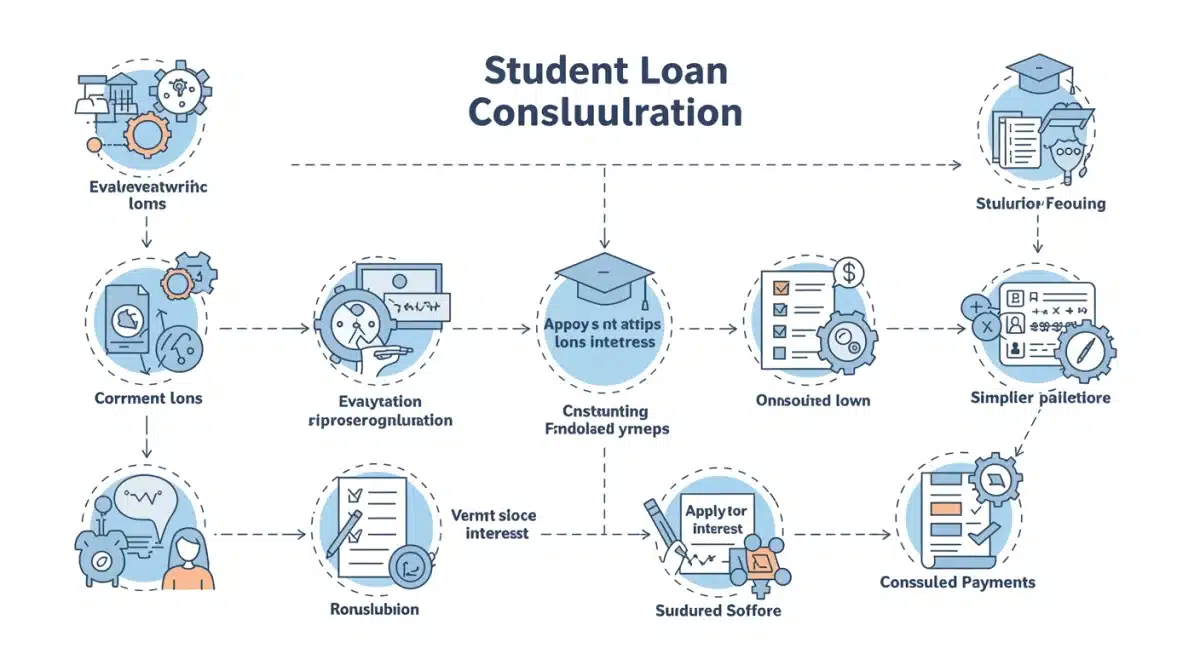
The first step involves gathering all necessary documentation. This includes details about your existing federal student loans, such as loan types, current balances, and servicer information. You’ll need to know whether your loans are Direct Subsidized Loans, Direct Unsubsidized Loans, FFEL Program loans, or Perkins Loans, as these are generally eligible for consolidation. The application itself is typically completed online through the Federal Student Aid website, a process that usually takes less than 30 minutes if you have all your information readily available.
The Application Process Explained
Once you’ve compiled your loan information, the application process unfolds as follows:
- Access the Federal Student Aid Website: Log in using your FSA ID. This is your digital signature for federal student aid.
- Complete the Direct Consolidation Loan Application: This involves selecting the loans you wish to consolidate, choosing a loan servicer for your new consolidated loan, and selecting a repayment plan.
- Choose a Repayment Plan: You’ll be presented with several options, including standard, graduated, extended, and various income-driven repayment (IDR) plans. IDR plans are particularly noteworthy for their ability to adjust monthly payments based on your income and family size, potentially leading to significant reductions.
- Review and Submit: Carefully review all information before submitting your application. Any inaccuracies could delay the process.
After submission, your chosen loan servicer will review your application. This can take several weeks. During this period, continue making payments on your existing loans until you receive official notification that your consolidation is complete and your new payment schedule has begun. It’s crucial not to miss any payments during this transition to avoid late fees and negative impacts on your credit score.
Upon approval, your existing federal loans will be paid off, and a new Direct Consolidation Loan will be issued. Your interest rate will be the weighted average of your old loans, rounded up to the nearest one-eighth of a percentage point. The new repayment term can be up to 30 years, depending on your loan balance and chosen repayment plan. This extension is often the key to lowering your monthly payments by the desired 10-15%.
Federal student loan consolidation in 2026 remains a robust option for managing federal student debt, offering both simplification and access to valuable borrower protections.
Exploring Private Student Loan Refinancing Options
For borrowers with private student loans, or those federal loan borrowers willing to forgo federal benefits for a potentially lower interest rate, private student loan refinancing (often colloquially referred to as consolidation) presents a viable alternative. This strategy involves securing a new loan from a private lender to pay off one or more existing student loans, with the aim of achieving a lower interest rate, a different repayment term, or a single monthly payment.
The landscape of private lenders is competitive in 2026, offering a range of options. Unlike federal consolidation, private refinancing is entirely credit-based. Lenders will thoroughly review your credit score, income, debt-to-income ratio, and employment history to determine your eligibility and the interest rate they can offer. A strong financial profile is key to securing the most favorable terms, potentially leading to significant savings and a reduction in your monthly payments.
What to Look for in a Private Lender
When considering private refinancing, it’s essential to shop around and compare offers from multiple lenders. Focus on these critical aspects:
- Interest Rates: Compare both fixed and variable interest rates. A lower rate is the primary driver for refinancing.
- Repayment Terms: Lenders offer various terms (e.g., 5, 10, 15, 20 years). A longer term can lower monthly payments but increases total interest paid.
- Fees: Be aware of any origination fees, application fees, or prepayment penalties. Reputable lenders often have no such fees.
- Borrower Protections: While not as robust as federal benefits, some private lenders offer limited deferment or forbearance options.
- Customer Service: Read reviews and assess the lender’s reputation for customer support.
Many private lenders offer online pre-qualification processes that allow you to see potential rates without impacting your credit score. This is an excellent way to compare offers without commitment. Once you select a lender, you’ll complete a full application, which will involve a hard credit inquiry. The lender will then verify your income and other financial details before approving the loan.
After approval, the new private lender will disburse funds to pay off your old loans. You will then begin making payments to your new private lender under the new terms. Remember, if you refinance federal loans into a private loan, you permanently lose access to federal benefits, so this decision should not be taken lightly. However, for those with high-interest private loans and excellent credit, this can be a powerful tool for achieving the 10-15% reduction in monthly payments.
Careful consideration and comparison are paramount when exploring private student loan refinancing options in 2026 to ensure you secure the best possible terms for your financial situation.
Strategies for Maximizing Payment Reduction
Achieving a 10-15% reduction in your monthly student loan payments through consolidation in 2026 requires more than just applying for a new loan; it demands strategic planning. Several approaches can help maximize your savings and make your consolidated loan truly beneficial.
One of the most effective strategies is to extend your repayment term. While this means paying more interest over the loan’s lifetime, it significantly lowers your monthly obligation. For federal loans, you can extend up to 30 years depending on your total loan balance. For private refinancing, lenders offer various terms, typically from 5 to 20 years. Carefully evaluate whether the short-term relief of lower payments outweighs the long-term cost of increased interest.
Optimizing Your Consolidation Outcome
To truly maximize your payment reduction and overall financial benefit, consider these strategies:
- Improve Your Credit Score: Before applying for private refinancing, work on improving your credit score. A higher score qualifies you for lower interest rates, directly impacting your monthly payment.
- Consider a Co-signer: If your credit isn’t stellar, a co-signer with excellent credit can help you secure a lower interest rate on a private consolidated loan.
- Shop Around for Lenders: Don’t settle for the first offer. Compare rates and terms from multiple federal and private lenders to find the most competitive option.
- Choose the Right Repayment Plan: For federal consolidation, carefully select an income-driven repayment plan if your income is modest, or an extended plan if you prioritize lower monthly payments over total interest paid.
Another powerful strategy, especially for private refinancing, is to secure a lower interest rate. Even a small reduction in interest can translate into significant savings over the life of the loan and a lower monthly payment. This is where having a strong credit profile comes into play. If your credit has improved since you took out your original loans, you are in a better position to negotiate favorable terms.
Furthermore, if you are consolidating federal loans, explore the various income-driven repayment (IDR) plans available. Plans like SAVE, PAYE, IBR, and ICR can adjust your monthly payments based on your discretionary income and family size, often resulting in payments as low as $0. These plans are designed to make federal loan repayment more affordable, and opting for one can be a direct route to achieving your payment reduction goals.
By combining an extended repayment term, a lower interest rate (where applicable), and the right repayment plan, you can strategically leverage student loan consolidation in 2026 to achieve a substantial 10-15% reduction in your monthly payments, making your student debt more manageable.
What to Expect in 2026: Policy and Market Trends
The student loan landscape is dynamic, with policy changes and market trends continually shaping borrower options. As we look ahead to 2026, understanding these potential shifts is crucial for anyone considering student loan consolidation. Remaining informed allows you to adapt your strategy and take advantage of new opportunities while mitigating potential risks.
One area of continuous evolution is federal student loan policy. Discussions around further student loan forgiveness programs, adjustments to income-driven repayment plans, and changes to interest rate calculations are ongoing. While definitive outcomes are never guaranteed, staying updated on legislative proposals and regulatory changes from the Department of Education can inform your decision-making. For instance, enhancements to the SAVE plan or new forgiveness initiatives could impact the attractiveness of federal consolidation versus private refinancing.
Anticipated Changes and Their Impact
Several factors are likely to influence student loan consolidation in 2026:
- Federal Policy Adjustments: Potential modifications to IDR plans, eligibility for forgiveness, and interest rate structures.
- Interest Rate Environment: The Federal Reserve’s monetary policy will continue to influence market interest rates, affecting private refinancing offers.
- Economic Conditions: A robust or struggling economy can impact lender willingness to offer competitive rates and borrowers’ ability to repay.
- Technological Advancements: Digital platforms and AI-driven tools may streamline the application and management of consolidated loans, making the process more efficient.
On the private lending side, market competition is expected to remain robust. This competition often benefits borrowers, as lenders strive to offer attractive interest rates and flexible terms to capture market share. However, interest rates are also influenced by broader economic conditions, including inflation and the Federal Reserve’s benchmark rates. We’ve seen periods of both rising and falling rates in recent years, and this volatility could continue. Borrowers with excellent credit will likely continue to find the most favorable private refinancing opportunities.
Technological advancements are also playing an increasing role. Online application processes are becoming more streamlined, and AI-powered tools may offer more personalized advice and loan product recommendations. These innovations can make the consolidation process more accessible and efficient for borrowers in 2026.
In conclusion, while the core principles of student loan consolidation remain, the specific details and optimal strategies can shift with policy and market trends. Staying informed, consulting with financial advisors, and continuously evaluating your options will be key to successfully leveraging consolidation to lower your monthly payments by 10-15% in 2026.
| Key Aspect | Brief Description |
|---|---|
| Loan Simplification | Combines multiple loans into one, simplifying payments and reducing administrative burden. |
| Payment Reduction | Achieve 10-15% lower monthly payments through extended terms or lower interest rates. |
| Federal vs. Private | Federal retains benefits; Private offers potentially lower rates but forfeits federal protections. |
| Strategic Planning | Evaluate credit, compare lenders, and choose optimal repayment plans for maximum benefit. |
Frequently Asked Questions About Student Loan Consolidation
The primary benefit is simplifying your repayment by reducing multiple monthly payments into one. This often comes with a new, potentially lower interest rate or an extended repayment term, which can significantly reduce your monthly payment obligations by 10-15%.
Yes, you can. However, federal loans can only be consolidated into a new federal Direct Consolidation Loan, or they can be refinanced along with private loans into a new private loan. Consolidating federal loans into a private loan means losing federal protections.
Initially, a hard credit inquiry for private refinancing can cause a temporary dip. However, simplifying payments and making consistent, on-time payments on a consolidated loan can improve your credit score over time by demonstrating responsible debt management.
The timeline varies. Federal Direct Consolidation Loan applications typically take 4-6 weeks to process. Private refinancing can be quicker, often completed within 2-4 weeks, depending on the lender and how quickly you provide necessary documentation.
Federal Direct Consolidation Loans do not have any application or origination fees. For private loan refinancing, most reputable lenders also do not charge these fees, but it’s crucial to confirm this with each individual lender before committing.
Conclusion
Navigating student loan debt can be a significant challenge, but with strategic planning, solutions like consolidation offer a tangible path toward financial relief. By carefully evaluating your current loans, understanding the distinctions between federal and private options, and leveraging the strategies outlined, you can effectively streamline your debt and potentially lower your monthly payments by a meaningful 10-15% in 2026. The key lies in informed decision-making, ensuring that the chosen path aligns with your long-term financial goals and provides the stability you seek.