Student Loan Refinancing vs. Consolidation 2026: Data-Backed Choices
Understanding the differences between student loan refinancing and consolidation is crucial for optimizing debt in 2026, offering distinct pathways to manage and potentially reduce your financial burden based on individual circumstances and market conditions.
Navigating the complex landscape of student loan debt in 2026 requires a clear understanding of your options. This article will delve into student loan refinancing versus consolidation, providing a data-backed comparison to help you optimize your debt over the next five years.
Understanding Student Loan Consolidation in 2026
Student loan consolidation in 2026 presents a viable strategy for borrowers seeking to simplify their repayment process. This approach specifically focuses on federal student loans, combining multiple existing federal loans into a single new Direct Consolidation Loan. The primary benefit is streamlining payments, making it easier to manage your debt.
While consolidation simplifies monthly payments, it’s important to understand its impact on interest rates. The new interest rate for a Direct Consolidation Loan is a weighted average of your existing loans’ rates, rounded up to the nearest one-eighth of a percentage point. This means consolidation typically won’t lower your interest rate, but it can extend your repayment period, potentially reducing your monthly payment.
Eligibility and Federal Benefits
Eligibility for a Direct Consolidation Loan is fairly broad, encompassing most federal student loans. Borrowers must generally be out of school or enrolled less than half-time to apply. One of the significant advantages of federal consolidation is the preservation of federal benefits and protections.
- Access to income-driven repayment (IDR) plans, which can adjust your monthly payments based on your income and family size.
- Eligibility for public service loan forgiveness (PSLF) and other federal forgiveness programs.
- Deferment and forbearance options in times of financial hardship, offering temporary payment relief.
For many, retaining these federal benefits is a critical factor, especially if their career path aligns with PSLF or if they anticipate future financial instability. The flexibility offered by federal programs can be a strong argument for choosing consolidation over refinancing, particularly for those with a high proportion of federal debt.
Ultimately, federal student loan consolidation in 2026 serves as a powerful organizational tool, simplifying debt management without sacrificing the safety nets provided by the federal government. It’s an excellent option for those who prioritize predictability and access to federal assistance programs.
Exploring Student Loan Refinancing in 2026
Student loan refinancing in 2026 offers a distinct path aimed primarily at reducing your interest rate and overall cost of debt. Unlike consolidation, refinancing involves taking out a new loan from a private lender to pay off one or more existing student loans, which can be federal, private, or a combination of both. The new loan will have a new interest rate and new terms, potentially saving you thousands over the life of the loan.
The core appeal of refinancing lies in securing a lower interest rate. This is particularly attractive for borrowers with excellent credit scores, stable income, and a strong employment history. Private lenders assess these factors to determine eligibility and the interest rate offered. A lower interest rate translates directly into reduced monthly payments and less interest paid over time.
Benefits and Considerations for Refinancing
Refinancing can significantly alter your financial trajectory. The potential for substantial savings is often the primary motivator. However, it’s crucial to weigh the benefits against potential drawbacks.
- Lower Interest Rates: A key advantage, especially if market rates are favorable and your credit profile has improved since you first took out your loans.
- Single Monthly Payment: Similar to consolidation, refinancing can combine multiple loans into one, simplifying your financial obligations.
- Flexible Terms: You might be able to choose a new loan term that better suits your budget, whether it’s a shorter term to pay off debt faster or a longer term for lower monthly payments.
A significant consideration for federal loan borrowers is that refinancing federal loans into a private loan means sacrificing federal protections like income-driven repayment plans, deferment, forbearance, and access to loan forgiveness programs. This trade-off must be carefully evaluated based on your personal financial situation and future plans.
In 2026, with evolving economic conditions, comparing refinancing offers from various private lenders is more important than ever. Utilize online comparison tools and seek pre-qualification to gauge potential rates without impacting your credit score. Refinancing is a strategic move for those confident in their financial stability and eager to minimize their long-term debt burden.
Key Differences: Consolidation vs. Refinancing
The distinction between student loan consolidation and refinancing is fundamental to making an informed financial decision in 2026. While both options aim to simplify debt management, their mechanisms, eligibility, and outcomes differ significantly. Understanding these differences is paramount to choosing the right path for your specific financial situation.
Consolidation, primarily for federal loans, combines them into a new federal loan. Its main goal is simplification and the preservation of federal benefits. The interest rate is a weighted average, meaning it rarely leads to significant interest savings. Refinancing, on the other hand, involves a private lender paying off your old loans (federal or private) with a new private loan. Its primary objective is to secure a lower interest rate, which can lead to substantial savings.
Impact on Interest Rates and Loan Terms
The most notable difference lies in the potential for interest rate reduction. With federal consolidation, your interest rate is unlikely to decrease; it’s a calculated average of your existing federal loans. This process doesn’t usually save you money on interest, but it can extend your repayment period, thus lowering your monthly payments.
Refinancing, however, can offer a significantly lower interest rate if you have strong credit and a good income. Private lenders compete for your business, and if your financial profile has improved since you first borrowed, you could qualify for much more favorable terms. This directly translates to paying less interest over the life of the loan and potentially a lower monthly payment, depending on the new loan term you select.
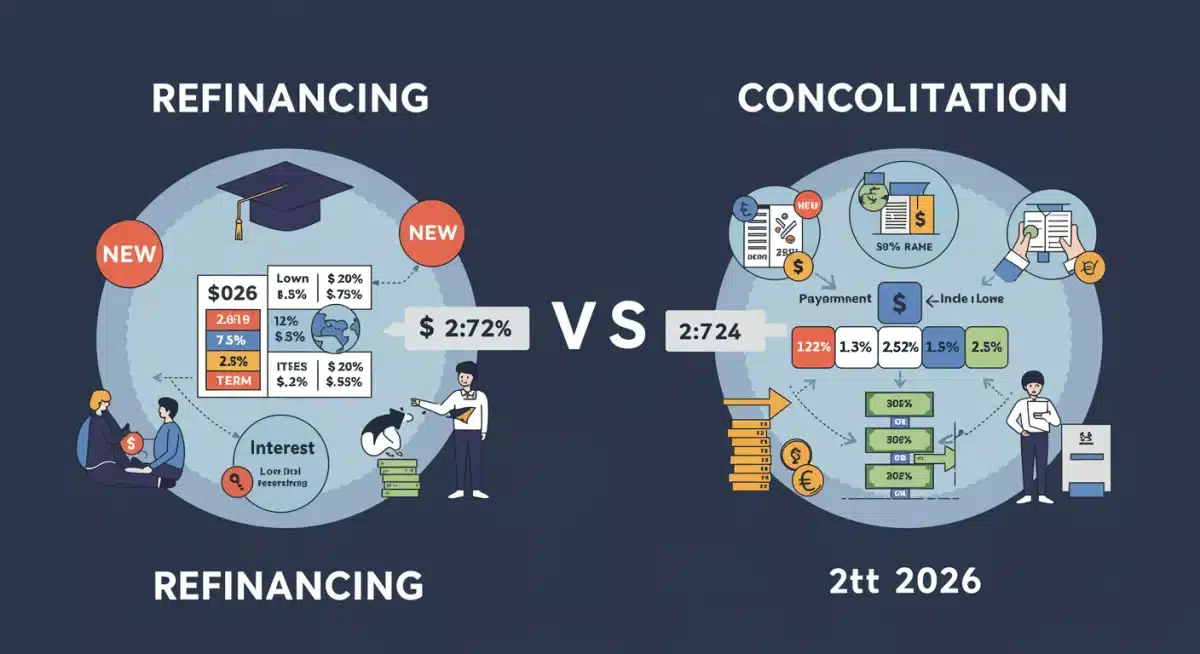
Furthermore, federal consolidation allows you to choose from various income-driven repayment plans and offers access to federal loan forgiveness programs. Refinancing with a private lender means forfeiting these federal protections. This trade-off is a critical consideration for many borrowers, especially those working in public service or who anticipate potential financial hardship.
Ultimately, the choice between consolidation and refinancing hinges on your priorities: simplifying federal loan management while retaining benefits (consolidation) versus potentially securing a lower interest rate and customizing terms (refinancing) at the cost of federal protections.
Data-Backed Insights on Student Loan Trends for 2026
Analyzing recent trends and projections for 2026 provides invaluable data-backed insights for student loan borrowers. Economic forecasts suggest continued fluctuation in interest rates, making strategic debt management more crucial than ever. Understanding these trends can help you anticipate market shifts and make timely decisions regarding your student loans.
Data from the past few years indicates a growing number of borrowers exploring private refinancing options, driven by competitive rates offered by private lenders, especially for those with excellent credit. Conversely, federal consolidation remains a consistent choice for borrowers prioritizing federal benefits and the stability of income-driven repayment plans, particularly as economic uncertainties persist.
Market Projections and Borrower Behavior
Projections for 2026 suggest that interest rates, while subject to Federal Reserve policy, may experience periods of both stability and slight increases. This dynamic environment means that securing a lower fixed rate through refinancing could be a highly advantageous move for eligible borrowers. Data shows that locking in a favorable rate can lead to significant long-term savings, insulating borrowers from future rate hikes.
- Increased demand for flexible repayment options, especially among younger generations entering the workforce.
- A sustained focus on federal loan forgiveness programs, influencing consolidation decisions for public service workers.
- Growth in personalized financial advisory services to navigate complex loan structures and repayment strategies.
Borrower behavior data in 2026 also highlights a trend towards greater financial literacy and active debt management. More individuals are utilizing online tools and financial advisors to compare options, understand repayment scenarios, and optimize their student loan portfolios. This proactive approach suggests a shift from passive repayment to strategic debt optimization.
These data-backed insights emphasize the importance of staying informed about economic conditions and lender offerings. Whether considering consolidation or refinancing, leveraging current information and future projections will be key to optimizing your student loan debt effectively over the next five years.
Optimizing Your Debt Over Five Years: A Strategic Approach
Optimizing your student loan debt over the next five years requires a strategic, forward-thinking approach. This involves not only understanding the mechanics of refinancing and consolidation but also aligning these options with your personal financial goals and anticipated life events. A well-executed strategy can lead to significant savings and greater financial freedom.
Begin by conducting a thorough audit of your current loans. Document each loan’s principal balance, interest rate, servicer, and remaining term. This comprehensive overview is the foundation for any sound debt optimization plan. Identify whether your loans are federal or private, as this distinction critically influences your available options.
Crafting Your Five-Year Debt Reduction Plan
Your five-year plan should incorporate a blend of short-term tactics and long-term objectives. For instance, if your primary goal is to reduce monthly payments immediately, federal consolidation with an extended repayment term might be appropriate. If, however, your aim is to minimize the total interest paid, refinancing to a lower interest rate with a shorter term could be more beneficial.
- Evaluate your credit score: A higher credit score can unlock better refinancing rates. Work on improving it if necessary.
- Project future income: Anticipate salary increases or career changes that might impact your ability to make larger payments or qualify for better loan terms.
- Consider life events: Major life events like buying a home, starting a family, or changing careers can affect your financial capacity and loan management strategy.
Regularly reassess your strategy. The financial landscape and your personal circumstances can change. What was the best option in 2026 might need adjustment by 2028. Stay informed about market interest rates, new loan products, and any changes in federal student loan policies. Utilizing online calculators and consulting with financial advisors can provide valuable insights and help fine-tune your plan.
By taking a proactive and adaptable approach to your student loan debt, you can effectively optimize your financial situation over the next five years, moving closer to your long-term financial aspirations.
Choosing the Right Path: Factors to Consider
Deciding between student loan refinancing and consolidation in 2026 is a highly personal choice influenced by numerous factors. There’s no one-size-fits-all answer; the optimal path depends on your financial stability, career trajectory, and tolerance for risk. A careful evaluation of these elements is crucial for making the most advantageous decision.
First, assess your current financial health. Do you have a stable income, an excellent credit score, and a low debt-to-income ratio? If so, refinancing with a private lender could offer substantial interest rate savings. Conversely, if your financial situation is less certain, or if you rely on federal benefits like income-driven repayment or potential loan forgiveness, federal consolidation might be the safer bet.
Personal Financial Goals and Risk Assessment
Your personal financial goals play a significant role. Are you aiming for the lowest possible monthly payment, even if it means paying more interest over time? Or is your priority to pay off your debt as quickly as possible, minimizing total interest costs? Refinancing often allows for more flexibility in choosing a loan term that aligns with these goals, while consolidation primarily focuses on simplifying federal loan management.
- Credit Score: A strong credit history is vital for securing competitive refinancing rates.
- Employment Stability: Private lenders prefer borrowers with a consistent employment record.
- Future Earning Potential: Consider how your income might change over the next five years and how that impacts your ability to repay.
- Tolerance for Risk: Are you comfortable forfeiting federal protections for potentially lower interest rates?
Furthermore, consider your eligibility for federal loan forgiveness programs. If you are working in public service, or anticipate doing so, consolidating your federal loans might be necessary to qualify for programs like PSLF. Refinancing federal loans into a private loan would make you ineligible for such programs, a trade-off that requires careful thought.
By meticulously weighing your financial situation, future goals, and risk tolerance, you can confidently choose between student loan refinancing and consolidation, setting yourself on the most beneficial path for debt optimization in 2026 and beyond.
| Key Feature | Description |
|---|---|
| Consolidation Focus | Combines multiple federal loans into one, simplifying payments and retaining federal benefits. |
| Refinancing Focus | Obtains a new private loan to pay off existing loans (federal/private), aiming for lower interest rates. |
| Interest Rate Impact | Consolidation averages rates; Refinancing often lowers rates based on credit. |
| Federal Benefits | Consolidation preserves them; Refinancing typically forfeits them. |
Frequently Asked Questions About Student Loan Optimization
No, federal student loan consolidation is exclusively for federal loans. If you have private student loans and wish to combine them or secure a lower interest rate, you would need to explore private student loan refinancing options. This process involves a private lender.
Refinancing aims to lower your interest rate, but it’s not guaranteed. Eligibility for a lower rate depends on your credit score, income, and debt-to-income ratio. Borrowers with excellent credit and stable finances are most likely to secure competitive, lower rates from private lenders in 2026.
Refinancing federal loans into a private loan means forfeiting crucial federal protections. These include access to income-driven repayment (IDR) plans, deferment and forbearance options, and eligibility for federal loan forgiveness programs like Public Service Loan Forgiveness (PSLF).
Yes, you can consolidate your federal loans first to gain access to certain federal programs or simplify them, and then later refinance the consolidated federal loan (along with any private loans) with a private lender. This approach allows you to leverage benefits from both strategies.
There’s generally no limit to how many times you can refinance private student loans. Many borrowers choose to refinance multiple times as their credit score improves or as market interest rates drop, allowing them to secure even more favorable terms and maximize savings over time.
Conclusion
The decision between student loan refinancing and consolidation in 2026 is a nuanced one, requiring a thorough understanding of each option’s unique benefits and drawbacks. While consolidation offers simplified payments and preserves federal protections for federal loans, refinancing with a private lender can lead to significant interest rate reductions, provided you have a strong financial profile. By carefully evaluating your personal circumstances, financial goals, and staying informed about market trends, you can make a data-backed choice that optimizes your student loan debt and contributes positively to your financial well-being over the next five years.