2025 EFC to SAI Transition: Impact on Your Financial Aid

The 2025 EFC to SAI transition fundamentally changes how federal student aid is calculated, replacing the Expected Family Contribution with the Student Aid Index to simplify the process and expand eligibility for financial assistance.
The landscape of federal student aid is undergoing its most significant transformation in decades, particularly with the 2025 EFC to SAI transition. This pivotal shift will redefine how financial need is assessed, impacting millions of students and families across the United States. Understanding these changes is not just beneficial; it’s essential for anyone planning to pursue higher education or currently navigating its costs.
Understanding the Shift from EFC to SAI
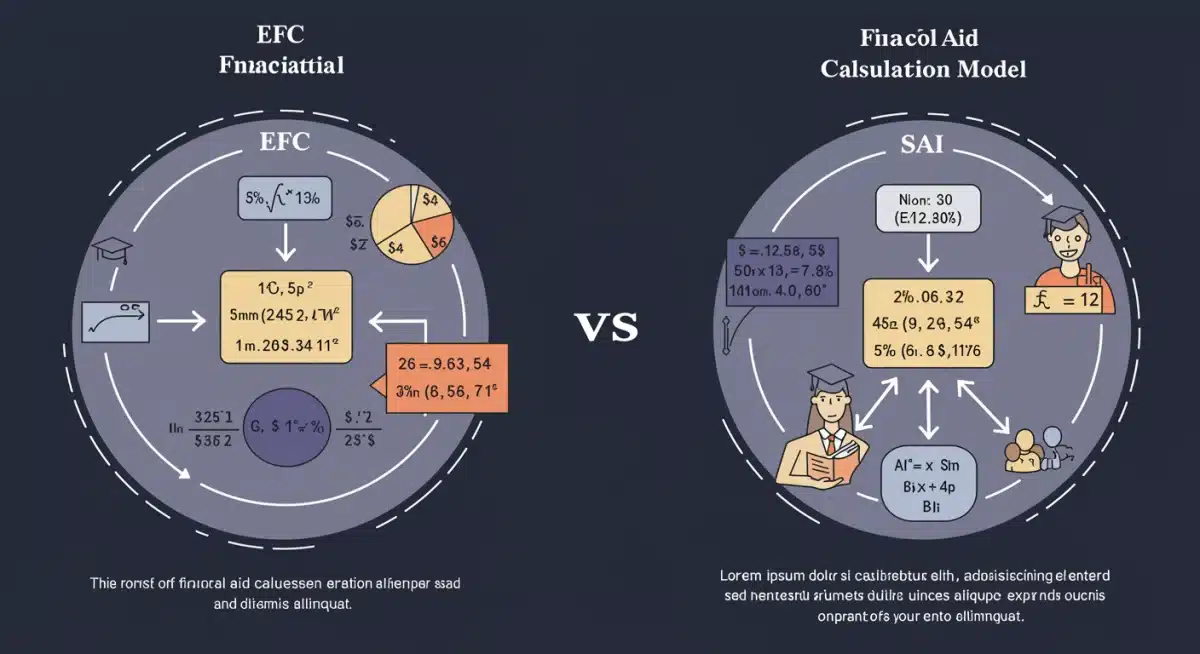
The move from the Expected Family Contribution (EFC) to the Student Aid Index (SAI) marks a fundamental change in how financial aid eligibility is determined. For years, the EFC has been a cornerstone of the Free Application for Federal Student Aid (FAFSA), providing a numerical value that colleges used to gauge a family’s ability to pay for college. However, this system often proved complex and, at times, opaque.
The new Student Aid Index (SAI) aims to simplify this process, making it more transparent and accessible. This transition is part of the broader FAFSA Simplification Act, designed to streamline the application, expand eligibility for federal Pell Grants, and ensure a more equitable distribution of financial aid. It’s a re-evaluation of how need is defined, moving towards a system that better reflects contemporary financial realities for many American families.
The Limitations of the EFC System
The EFC, while serving its purpose for decades, had inherent complexities that often created barriers for applicants. Its calculation involved numerous variables, some of which were not always clear to families completing the FAFSA. This complexity could lead to confusion and frustration, potentially deterring eligible students from applying for aid.
- Complicated calculation formulas.
- Inconsistent treatment of certain assets.
- Lack of clarity for applicants.
- Potential for misinterpretation by aid offices.
These limitations underscored the need for a more straightforward and understandable system, paving the way for the SAI. The goal is to provide a more accurate and consistent measure of a student’s financial need, ultimately making the financial aid process less daunting.
The EFC often presented a number that many families felt did not accurately represent their ability to pay, leading to a disconnect between the calculated contribution and actual financial strain. This discrepancy is one of the primary reasons for the legislative push to overhaul the system, recognizing that a more intuitive index could better serve students seeking assistance.
Key Changes Introduced by the SAI
The introduction of the Student Aid Index (SAI) brings several significant changes to the financial aid calculation methodology. These modifications are designed to make the process more student-friendly and to align aid eligibility with current economic conditions. Families need to be aware of these changes to accurately anticipate their financial aid prospects.
One of the most notable changes is the replacement of the term ‘Expected Family Contribution’ with ‘Student Aid Index.’ This change in terminology reflects a broader philosophical shift, moving away from the idea that a family is expected to contribute a specific amount, and instead focusing on an index that helps determine aid eligibility. The SAI can even be a negative number, indicating a higher level of financial need.
New Calculation Factors and Exclusions
The SAI calculation incorporates several new factors while also excluding others that were previously part of the EFC. For instance, the number of family members in college will no longer be a factor in the SAI calculation, which could impact families with multiple children pursuing higher education simultaneously. This particular change has generated considerable discussion among financial aid experts and families alike.
- No longer considers the number of family members in college.
- Child support received will now be excluded from aid calculations.
- New allowances for certain expenses in the calculation.
- Income protection allowances are increased.
These adjustments aim to provide a more nuanced picture of a family’s financial situation, potentially increasing eligibility for some while decreasing it for others. The exclusion of child support received, for example, is a significant change that could benefit single-parent households previously penalized by its inclusion.
Furthermore, the new FAFSA will allow for a negative SAI, down to -1500. A negative SAI indicates a higher level of financial need, which could lead to increased Pell Grant eligibility for the lowest-income students. This is a crucial aspect of the simplification act, directly addressing concerns about adequate support for students from disadvantaged backgrounds.
Impact on Your Expected Family Contribution
The transition from EFC to SAI fundamentally alters how your financial need is assessed, directly impacting what was formerly known as your Expected Family Contribution. For many families, this means a new calculation will yield a different SAI number, which in turn dictates the amount of federal and institutional aid they may receive. It’s crucial to understand that a lower SAI generally correlates with a higher eligibility for financial aid.
The shift is not merely a name change; it involves a revised methodology that could result in varying aid packages depending on individual circumstances. Some families may find their calculated need increases, leading to more aid, while others might see a reduction. This variability underscores the importance of familiarizing oneself with the new FAFSA and the SAI calculation process.
Who Benefits Most from the SAI?
The FAFSA Simplification Act, and by extension the SAI, was designed with a clear intent: to expand access to federal student aid, particularly for students with the greatest financial need. As such, certain groups are expected to benefit more significantly from these changes. This includes low-income students and those from single-parent households, who may see a substantial increase in their aid eligibility.
- Low-income students, especially those eligible for Pell Grants.
- Single-parent households due to the exclusion of child support.
- Families with modest assets no longer counting against them as heavily.
- Applicants with significant income protection allowances.
The ability for the SAI to be a negative number is a direct mechanism to identify and support students with the most profound financial challenges. This provision ensures that federal aid can be directed more effectively to those who need it most, potentially opening doors to higher education that were previously closed.
Conversely, some families, particularly those with multiple children in college, might find their aid eligibility reduced under the new rules, as the multi-student discount is eliminated. This highlights the complex and sometimes unpredictable nature of these sweeping changes, making personalized assessment essential for every applicant.
Navigating the New FAFSA Application Process
With the 2025 EFC to SAI transition comes a redesigned FAFSA application, promising a more streamlined and user-friendly experience. The aim is to reduce the time and effort required to complete the application, encouraging more students to apply for federal aid. While the core purpose remains the same—to determine eligibility for federal student aid—the mechanics of the application have been significantly overhauled.
Applicants will notice a substantial reduction in the number of questions, simplifying what was once a lengthy and often confusing process. This simplification is intended to make the FAFSA more accessible, particularly for first-generation college students and those from underserved communities who might have been intimidated by the previous iteration.
Simplified FAFSA and Data Retrieval
A key enhancement in the new FAFSA is the improved integration with IRS data retrieval. This feature allows for the direct import of tax information, minimizing manual entry and reducing the likelihood of errors. All contributors (students, parents, spouses) will now need to provide consent for their tax data to be directly transferred from the IRS.

- Fewer questions on the application form.
- Mandatory consent for direct IRS data retrieval from all contributors.
- More intuitive design for a better user experience.
- Expanded online resources and support for applicants.
The requirement for all contributors to provide consent for direct IRS data transfer is a critical change. Without this consent, the student will not be eligible for federal student aid, regardless of their financial need. This emphasizes the importance of clear communication and cooperation among family members during the application process.
The new FAFSA is also designed to be mobile-friendly, allowing students and families to complete the application from various devices. This increased accessibility is a crucial step towards ensuring that financial aid is within reach for a broader spectrum of the population, reflecting a commitment to equity in higher education.
Strategies for Maximizing Your Financial Aid
In light of the 2025 EFC to SAI transition, it’s more important than ever for students and families to develop effective strategies for maximizing their financial aid eligibility. Understanding the nuances of the new SAI calculation and the simplified FAFSA can empower you to make informed decisions that positively impact your aid package. Proactive planning and accurate reporting are key components of this process.
While the new system aims to simplify, it still requires careful attention to detail. Families should not assume that the changes will automatically lead to a better outcome without understanding how their specific financial situation aligns with the new criteria. Seeking guidance from financial aid professionals or utilizing available resources can be invaluable.
Key Considerations for Aid Optimization
To optimize your financial aid, consider several factors that now play a more significant role in the SAI calculation. For example, understanding how assets are treated, or the impact of certain types of income, can help you strategically plan your finances. It’s not about hiding assets, but rather understanding how they are assessed under the new rules.
- Understand the new asset protection allowances.
- Be aware of how parental and student income are now weighted.
- File your FAFSA as early as possible each year.
- Consider professional financial aid advising for complex situations.
The timing of your FAFSA submission remains critical, as some aid is awarded on a first-come, first-served basis. Submitting your application promptly after it becomes available ensures you are considered for the widest range of aid opportunities, including institutional grants and scholarships that often have limited funding.
Additionally, pay close attention to any changes in your financial circumstances between FAFSA submissions. Significant life events, such as job loss, medical expenses, or changes in family size, can impact your eligibility and may warrant an appeal to your college’s financial aid office for a professional judgment review.
Future Outlook and Continued Evolution of Financial Aid
The 2025 EFC to SAI transition is a monumental step, but it’s part of an ongoing evolution in federal financial aid policy. The landscape of higher education funding is dynamic, constantly adapting to economic shifts, societal needs, and legislative priorities. Understanding this broader context can help students and families prepare for future changes and remain adaptable in their financial planning.
The FAFSA Simplification Act itself is a testament to the continuous effort to refine and improve the financial aid system, aiming for greater equity and accessibility. While the immediate focus is on the SAI, it’s reasonable to expect further adjustments and enhancements as the new system is implemented and its effects are thoroughly evaluated.
Anticipating Further Reforms
Financial aid policies are rarely static. As economic conditions change and new challenges emerge, policymakers often revisit existing regulations. Future reforms could focus on areas such as student loan repayment, grant program expansions, or further simplification of the application process. Staying informed through reliable sources will be crucial.
- Potential for additional legislative changes to federal aid.
- Increased focus on student loan debt and repayment strategies.
- Continued efforts to expand Pell Grant eligibility.
- Greater emphasis on financial literacy and guidance for students.
The conversation around student debt and its impact on the economy continues to gain traction, suggesting that future reforms may well target student loan programs. This could include changes to interest rates, repayment plans, or even expanded forgiveness options, all of which would significantly affect students’ long-term financial health.
Ultimately, the goal of these ongoing reforms is to ensure that higher education remains an achievable dream for all qualified students, regardless of their socioeconomic background. By staying engaged and informed, families can better navigate the complexities of financial aid and make the most of the opportunities available to them.
| Key Point | Brief Description |
|---|---|
| EFC to SAI Transition | Replaces Expected Family Contribution (EFC) with Student Aid Index (SAI) for federal aid calculation. |
| New Calculation | Simplified formula, can result in a negative SAI, indicating higher need. |
| FAFSA Simplification | Fewer questions, mandatory IRS data retrieval consent, improved user experience. |
| Impact on Aid | Aims to expand Pell Grant eligibility, especially for low-income students. |
Frequently Asked Questions About the SAI Transition
The EFC (Expected Family Contribution) is being replaced by the SAI (Student Aid Index). The SAI uses a simplified calculation, can be a negative number, and aims to more accurately reflect a student’s financial need, expanding eligibility for federal aid programs like the Pell Grant.
The new FAFSA will have significantly fewer questions, making it quicker and easier to complete. It will also feature improved direct data exchange with the IRS, reducing manual entry and minimizing errors for applicants. This aims for a more user-friendly experience.
No, a significant change is that the number of family members attending college will no longer be a factor in the SAI calculation. This could alter aid eligibility for families with multiple children pursuing higher education simultaneously, potentially reducing aid for some.
Yes, under the new system, the Student Aid Index (SAI) can be a negative number, down to -1500. A negative SAI indicates a higher level of financial need, which can lead to increased eligibility for Pell Grants and other federal student aid for the lowest-income students.
Providing consent for direct IRS data retrieval is mandatory for all contributors (student, parents, spouse). Without this consent, the student will not be eligible for federal student aid, making it a critical step in the application process regardless of income level.
Conclusion
The 2025 EFC to SAI transition represents a profound restructuring of how federal financial aid is calculated and distributed. This shift, driven by the FAFSA Simplification Act, aims to create a more equitable, transparent, and accessible system for all students seeking higher education. While the changes bring simplification and expanded eligibility for many, particularly low-income students, they also necessitate a thorough understanding of the new methodologies for all applicants. Proactive engagement with the updated FAFSA, awareness of the SAI’s calculation factors, and strategic financial planning are crucial for maximizing aid opportunities in this evolving landscape. Ultimately, these reforms are designed to ensure that the dream of higher education remains within reach for a broader segment of the American population, fostering a more educated and financially secure future.