
Navigating the Shifting Sands: Understanding Crypto Tax Regulations 2026
The world of digital assets is in constant flux, and perhaps no area is changing more rapidly than its regulatory landscape. As we approach 2026, the anticipated Crypto Tax Regulations 2026 promise to bring a new era of clarity, complexity, and compliance demands for investors worldwide. For anyone involved in cryptocurrencies, NFTs, DeFi, or any other form of digital asset, understanding and preparing for these changes isn’t just advisable – it’s absolutely essential for financial well-being and legal adherence.
This comprehensive guide aims to demystify the upcoming Crypto Tax Regulations 2026, providing a detailed roadmap for digital asset investors. We’ll explore the driving forces behind these new rules, delve into the specifics of what’s expected, and offer actionable strategies to ensure you’re not just compliant, but also strategically positioned to thrive in the evolving digital economy. From understanding reporting mechanisms to optimizing your portfolio for tax efficiency, consider this your essential resource for navigating the future of crypto taxation.
The Evolution of Digital Asset Taxation: Why 2026 Matters
The journey of digital assets from fringe technology to mainstream investment has been swift and disruptive. However, regulatory frameworks, particularly in taxation, have struggled to keep pace. Governments globally have recognized the immense potential of blockchain technology and cryptocurrencies, but also the challenges they pose to traditional tax collection and financial oversight. The year 2026 is poised to be a landmark year because many jurisdictions, often influenced by international bodies like the OECD, are expected to implement more standardized and robust reporting frameworks.
Historically, crypto taxation has been a patchwork, with interpretations varying widely by country and even within regions. This ambiguity has led to both unintentional non-compliance and opportunities for tax evasion. The push for more unified Crypto Tax Regulations 2026 stems from several key factors:
- Increased Adoption: With millions of people globally holding digital assets, the tax revenue potential is too significant for governments to ignore.
- Market Maturity: The digital asset market has matured beyond speculative trading, encompassing complex financial instruments like DeFi lending, staking, and NFTs, all of which have unique tax implications.
- International Cooperation: Organizations like the OECD are developing frameworks such as the Crypto-Asset Reporting Framework (CARF) to ensure consistent global reporting standards, making it harder for individuals to arbitrage tax jurisdictions.
- Technological Advancements: Improved blockchain analytics and data collection tools empower tax authorities to track transactions more effectively.
These factors collectively underscore the critical importance of understanding the impending Crypto Tax Regulations 2026. Ignoring these changes could lead to significant penalties, audits, and legal complications. Proactive preparation is not just about avoiding trouble; it’s about building a sustainable and compliant digital asset strategy for the long term.
Key Pillars of the Expected Crypto Tax Regulations 2026
While the exact specifics of Crypto Tax Regulations 2026 will vary by jurisdiction, several overarching themes and requirements are expected to emerge as common global standards. These pillars will form the foundation of how digital assets are taxed and reported in the coming years.
1. Comprehensive Reporting Requirements
One of the most significant shifts will be toward more comprehensive and standardized reporting. Tax authorities will demand greater transparency regarding all digital asset transactions. This includes:
- Transaction History: Detailed records of all buys, sells, trades, swaps, and transfers.
- Cost Basis Tracking: Accurate tracking of the original purchase price (cost basis) for every digital asset to correctly calculate capital gains or losses.
- Fair Market Value: Reporting the fair market value of digital assets at the time of taxable events, often in fiat currency.
- Identification of Taxable Events: Clearly distinguishing between taxable events (e.g., selling crypto for fiat, trading one crypto for another, using crypto to purchase goods/services) and non-taxable events (e.g., simply holding crypto, transferring between your own wallets).
- Income from Crypto Activities: Reporting income from staking, mining, DeFi lending, airdrops, forks, and other revenue-generating activities.
Platforms and exchanges are also likely to face increased obligations to report user activities directly to tax authorities, similar to how traditional financial institutions issue 1099 forms. This shift will significantly reduce the burden on individual investors to self-report every single transaction, but it will also mean less room for error or omission.
2. Clarification on Asset Classification
A persistent challenge in crypto taxation has been the classification of digital assets. Are they currencies, commodities, securities, or property? The Crypto Tax Regulations 2026 are expected to provide clearer guidance, which will directly impact how different assets are taxed:
- Capital Assets: Most cryptocurrencies held for investment are treated as capital assets, subject to capital gains tax upon sale or exchange.
- Income: Rewards from staking, mining, airdrops, and DeFi interest are typically treated as ordinary income at the time they are received, based on their fair market value.
- NFTs: Non-fungible tokens (NFTs) will likely be classified based on their underlying nature – as collectibles, art, or potentially even securities in some cases – each with distinct tax implications.
- Stablecoins: The tax treatment of stablecoins will also receive clearer definitions, especially concerning their role in transactions and potential for interest generation.
Understanding these classifications is vital for applying the correct tax rules and avoiding miscalculations.
3. Focus on DeFi and NFTs
Decentralized Finance (DeFi) and Non-Fungible Tokens (NFTs) have exploded in popularity, introducing novel tax challenges. The Crypto Tax Regulations 2026 will undoubtedly address these complex areas:
- DeFi Lending and Borrowing: How interest earned, collateral provided, and liquidation events are taxed.
- Liquidity Providing: The tax implications of providing liquidity to decentralized exchanges (DEXs), including impermanent loss and rewards.
- NFT Sales and Royalties: Taxation of primary and secondary NFT sales, including creator royalties.
- Token Swaps and Bridging: Clarification on whether these activities constitute taxable events.
These areas often involve multiple transactions and complex calculations, making accurate record-keeping and specialized tax software increasingly important.
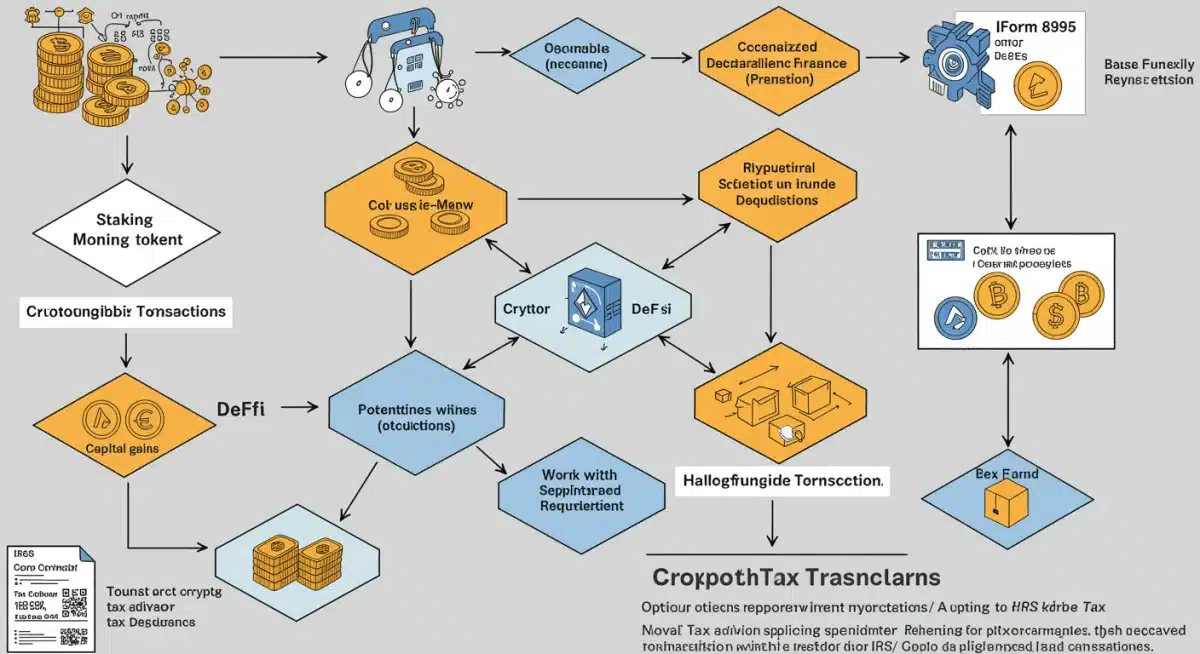
Strategic Preparation for Crypto Tax Regulations 2026
Proactive preparation is the cornerstone of successful navigation through the upcoming Crypto Tax Regulations 2026. Here’s how digital asset investors can get ready:
1. Implement Robust Record-Keeping Practices
This is perhaps the single most important step. Without accurate records, demonstrating compliance will be incredibly difficult. You should meticulously record:
- Date and Time of Every Transaction: Essential for establishing holding periods (short-term vs. long-term capital gains).
- Type of Transaction: Buy, sell, trade, gift, spend, stake, mine, airdrop, etc.
- Quantity of Crypto Involved: The exact amount of each digital asset.
- Fair Market Value at Transaction Time: The value in your local fiat currency (e.g., USD, EUR) at the exact moment of the transaction.
- Source and Destination Wallets/Exchanges: To trace the flow of assets.
- Transaction Fees: These can often be added to the cost basis or deducted.
- Purpose of Transaction: For example, ‘purchased BTC for investment’ or ‘paid for goods with ETH’.
Many exchanges provide transaction histories, but consolidating data from multiple platforms, wallets, and DeFi protocols can be challenging. This leads to the next crucial step.
2. Leverage Crypto Tax Software
Manual tracking of hundreds or thousands of crypto transactions is virtually impossible for most active investors. Dedicated crypto tax software solutions are becoming indispensable tools for preparing for Crypto Tax Regulations 2026. These platforms can:
- Integrate with Exchanges and Wallets: Automatically import your transaction data from various sources.
- Calculate Cost Basis: Apply different accounting methods (FIFO, LIFO, HIFO, etc.) to optimize tax outcomes.
- Identify Taxable Events: Automatically classify transactions and calculate gains/losses or income.
- Generate Tax Reports: Produce required forms (e.g., IRS Form 8949, Schedule D) and comprehensive reports for your accountant or self-filing.
- Handle Complex Scenarios: Many advanced tools are now capable of tracking DeFi interactions, NFT sales, and staking rewards.
Research and choose a reputable software that supports the specific digital assets and activities you engage in, and ideally, one that keeps up-to-date with evolving Crypto Tax Regulations 2026.
3. Understand Your Jurisdiction’s Specifics
While global standards are emerging, each country will have its own interpretation and implementation of the Crypto Tax Regulations 2026. What constitutes capital gains, ordinary income, or even a taxable event can differ significantly. For example:
- The United States generally treats crypto as property, subject to capital gains tax.
- Some European countries differentiate between short-term and long-term holdings with varying tax rates or even exemptions after a certain holding period.
- India has introduced a flat 30% tax on crypto gains, with no deductions for losses.
Stay informed about the specific tax laws in your country of residence. Consult local tax authorities’ guidance or a qualified tax professional specializing in digital assets.
4. Seek Professional Tax Advice
Given the complexity and evolving nature of Crypto Tax Regulations 2026, engaging with a tax professional who specializes in digital assets is highly recommended. They can provide personalized advice on:
- Tax Optimization Strategies: Identifying opportunities to minimize your tax liability legally, such as tax-loss harvesting.
- Complex Transaction Handling: Navigating the nuances of DeFi, NFTs, and other advanced crypto activities.
- Audit Representation: Assisting if you receive an inquiry or audit from tax authorities.
- Staying Compliant: Ensuring all filings are accurate and submitted on time according to the latest regulations.
Don’t wait until tax season to seek help; proactive consultation can save you significant headaches and money in the long run.
Common Taxable Events Under Crypto Tax Regulations 2026
To prepare effectively, it’s crucial to recognize what constitutes a taxable event in the eyes of tax authorities. While specific rules may vary, these are generally considered taxable incidents:
- Selling Crypto for Fiat Currency: The most straightforward taxable event.
- Trading One Cryptocurrency for Another: For example, exchanging Bitcoin for Ethereum. This is considered a sale of the first crypto and a purchase of the second.
- Using Crypto to Purchase Goods or Services: Spending crypto is treated as a disposition, similar to a sale.
- Receiving Crypto as Income: This includes mining rewards, staking rewards, airdrops, and payments for services rendered in crypto.
- Gifting Crypto Above a Certain Threshold: While gifting itself might not be a taxable event for the giver, exceeding certain limits can trigger gift tax implications or reporting requirements.
- DeFi Activities: Earning interest from lending, providing liquidity, or receiving governance tokens can be taxable.
- NFT Sales: Selling an NFT, whether it’s your own creation or one you purchased, is generally a taxable event.
It’s equally important to understand non-taxable events, which typically include transferring crypto between your own wallets or holding crypto without any disposition.
Tax Optimization Strategies in Light of 2026 Regulations
Beyond mere compliance, smart investors will look for ways to optimize their tax position within the framework of Crypto Tax Regulations 2026. Here are a few strategies:
- Tax-Loss Harvesting: Selling assets at a loss to offset capital gains or even a limited amount of ordinary income. This strategy is particularly effective in volatile crypto markets.
- Long-Term vs. Short-Term Gains: Holding assets for longer than a specific period (e.g., one year in the U.S.) can qualify them for lower long-term capital gains tax rates. Strategically planning dispositions can significantly reduce your tax burden.
- Choosing the Right Cost Basis Method: Depending on your jurisdiction, you might have options like FIFO (First-In, First-Out), LIFO (Last-In, First-Out), or HIFO (Highest-In, First-Out). Selecting the optimal method can impact your taxable gains.
- Gifting Strategies: Understanding gift tax exclusions and rules can help in transferring wealth without incurring immediate tax liabilities.
- Retirement Accounts: Exploring options for holding crypto in tax-advantaged retirement accounts (if permitted in your jurisdiction) can defer or reduce taxes.
Always consult with a tax professional before implementing any tax optimization strategy, as rules vary and personal circumstances dictate the best approach.

The Role of Exchanges and Third-Party Reporting
A significant aspect of Crypto Tax Regulations 2026 will likely be the increased burden on crypto exchanges, brokers, and potentially even DeFi protocols to report user activity to tax authorities. This mirrors the existing framework in traditional finance where banks and brokerage firms issue tax forms (like 1099s) to both customers and the IRS.
The OECD’s CARF, for instance, proposes that crypto-asset service providers (CASPs) should collect and report information on crypto-asset transactions. This means that if you’re using a centralized exchange, they will likely be required to report your trading volume, gains, and other relevant data directly to your country’s tax agency. This development emphasizes the importance of:
- Using Reputable Platforms: Stick to exchanges and services that are known for their compliance efforts and transparency.
- Verifying Your Data: Even with third-party reporting, it remains your ultimate responsibility to ensure the accuracy of your tax filings. Cross-reference data provided by exchanges with your own records.
- Understanding Data Sharing Agreements: Be aware of what information your chosen platforms collect and how they might share it with tax authorities, especially across international borders.
This shift will make it significantly harder for investors to avoid tax obligations, underscoring the necessity of proactive compliance.
Challenges and Future Outlook for Crypto Tax Regulations 2026
While the goal of Crypto Tax Regulations 2026 is to bring clarity, challenges will undoubtedly persist:
- Rapid Technological Innovation: The crypto space evolves faster than regulation. New protocols, assets, and financial instruments will continue to emerge, potentially outstripping existing tax guidance.
- Data Aggregation: Even with software, consolidating data from highly fragmented ecosystems (multiple blockchains, self-custody wallets, DEXs, CEXs, NFTs, etc.) remains a hurdle.
- Privacy Concerns: Increased reporting requirements raise privacy concerns for some users, prompting discussions around balancing transparency with individual data protection.
- Enforcement: The ability of tax authorities to effectively enforce these regulations, especially across borders, will be a critical determinant of their success.
Despite these challenges, the trend towards greater regulation and taxation of digital assets is irreversible. Investors should expect a continuous evolution of these rules beyond 2026, with further refinements and expansions as the market matures. Staying abreast of legislative developments and adapting your strategies accordingly will be an ongoing task.
Conclusion: Embracing Compliance for a Sustainable Digital Future
The upcoming Crypto Tax Regulations 2026 represent a pivotal moment for the digital asset industry. They signal a clear move towards mainstream acceptance and integration of cryptocurrencies and blockchain technology into the traditional financial system. For investors, this means a shift from a largely unregulated frontier to a more structured and accountable environment.
Embracing these regulations is not just about avoiding penalties; it’s about building a sustainable future for your digital asset investments. By prioritizing meticulous record-keeping, utilizing advanced tax software, seeking expert advice, and staying informed about jurisdictional specifics, you can confidently navigate the complexities of Crypto Tax Regulations 2026.
The digital asset landscape is dynamic, and so too will be its tax implications. View these changes not as obstacles, but as opportunities to solidify your financial practices, optimize your portfolio, and contribute to the legitimacy and long-term growth of the decentralized economy. Proactive engagement with these regulations will empower you to not only comply but also to thrive in the exciting years ahead.