Student Aid Index 2026: Your Essential Guide to the New Financial Aid Metric

Understanding the intricacies of financial aid can often feel like navigating a labyrinth, especially with the continuous evolution of policies and metrics. For students and families planning for college in the upcoming years, a crucial new term has emerged: the Student Aid Index (SAI) 2026. This isn’t just another acronym; it represents a fundamental shift in how federal student aid is calculated and distributed, replacing the long-standing Expected Family Contribution (EFC). This comprehensive guide aims to demystify the SAI, providing a full breakdown of its implications, calculation, and what you need to know to prepare for its impact.
The transition from EFC to SAI is more than a simple name change. It reflects a broader effort by the U.S. Department of Education to simplify the Free Application for Federal Student Aid (FAFSA) process and make financial aid more accessible and equitable. While the full implementation of the new FAFSA Simplification Act has been a multi-year process, understanding the Student Aid Index (SAI) 2026 is paramount for anyone considering higher education in the 2026-2027 academic year and beyond. This article will delve into the core components of the SAI, highlight the key differences from the EFC, and offer actionable advice for maximizing your eligibility for federal student aid.
What is the Student Aid Index (SAI)?
At its core, the Student Aid Index (SAI) is an eligibility index number that financial aid administrators use to determine how much federal student aid a student is eligible to receive. Unlike the EFC, which theoretically represented the amount a family could expect to pay, the SAI is simply an index number. It can be a negative number, as low as -1500, indicating a higher level of financial need and potentially greater eligibility for need-based aid. This is a significant departure from the EFC, which could never be less than zero.
The introduction of the Student Aid Index (SAI) 2026 is part of the FAFSA Simplification Act, a legislative overhaul designed to streamline the financial aid application process, expand Pell Grant eligibility, and provide a more accurate assessment of a student’s financial need. The goal is to make higher education more affordable and accessible to a wider range of students, particularly those from low-income backgrounds.
Key Objectives of the SAI and FAFSA Simplification:
- Simplification: Reducing the number of questions on the FAFSA form to make it easier and faster to complete.
- Increased Eligibility: Expanding Pell Grant eligibility to more students based on family size and federal poverty levels.
- Transparency: Providing a clearer, more consistent method for determining aid eligibility.
- Equity: Addressing historical inequities in the financial aid system to better support underserved populations.
For the 2026-2027 award year, the Student Aid Index (SAI) 2026 will be fully integrated into the financial aid process, meaning that all calculations and aid determinations will be based on this new metric. It’s crucial for students and families to understand how this index is derived and what factors influence it, as this knowledge will directly impact their financial aid outcomes.
How is the Student Aid Index (SAI) Calculated for 2026?
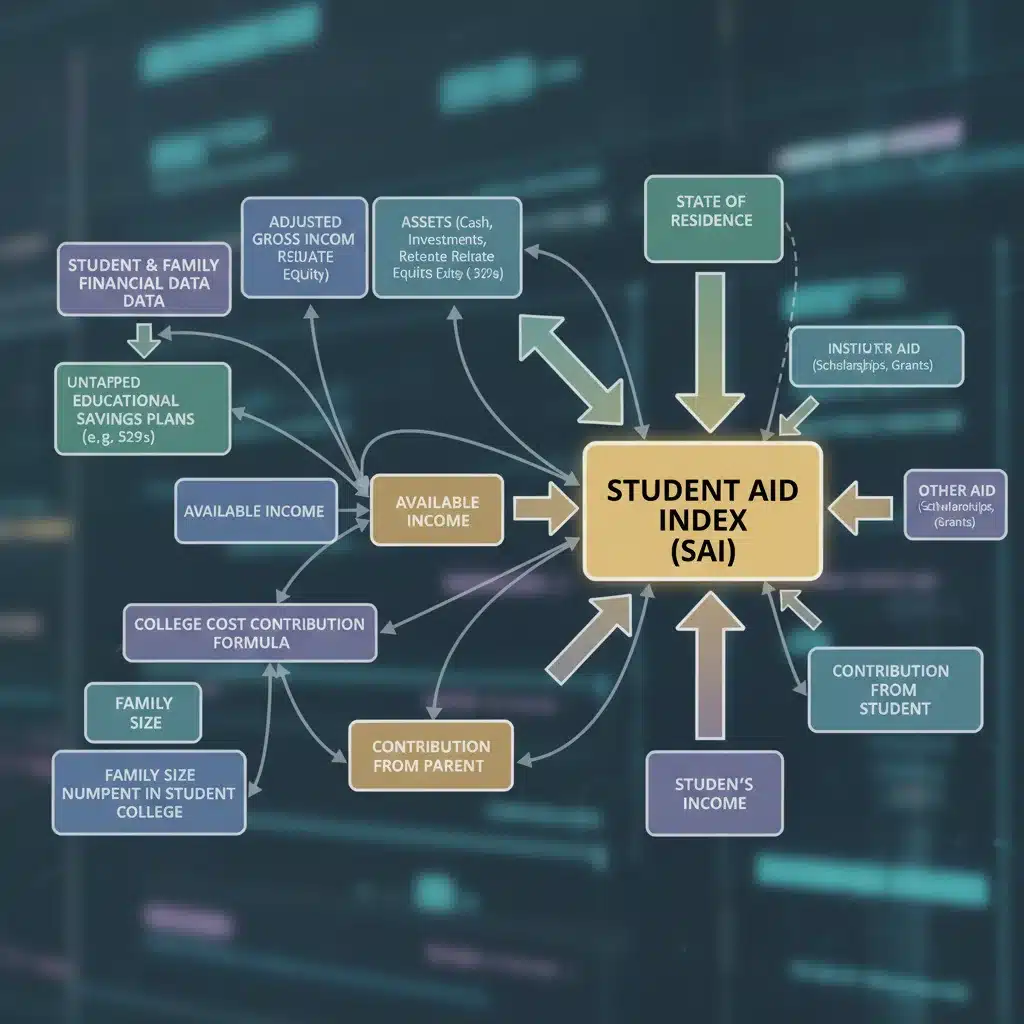
The calculation of the Student Aid Index (SAI) 2026 involves several key components, drawing information directly from the FAFSA. While the exact formula can be complex, understanding the major inputs is vital. The new methodology places a greater emphasis on income and family size, while also making changes to how assets are considered.
Income and Assets: The Core Components
- Adjusted Gross Income (AGI): This remains a primary factor. The FAFSA will primarily pull AGI data directly from the IRS using a direct data exchange, simplifying the process and reducing errors.
- Untaxed Income and Benefits: Certain untaxed income and benefits, such as child support received, will continue to be factored into the calculation.
- Assets: How assets are treated has undergone significant changes.
- Family Farm and Small Business Exclusion: A major change for the Student Aid Index (SAI) 2026 is that the net worth of family farms and small businesses (with 100 or fewer full-time employees) will no longer be counted as assets. This is a significant benefit for many families who previously saw their aid eligibility reduced due to these assets.
- Cash, Savings, and Checking Accounts: These liquid assets will still be considered.
- Investments: Non-retirement investments will be included, similar to the EFC calculation, but with some adjustments.
- Retirement Accounts: Funds held in qualified retirement accounts (e.g., 401(k), IRA) are excluded from the SAI calculation, which is a consistent policy.
Family Size and Household Information: A Greater Emphasis
Under the new FAFSA Simplification Act and the Student Aid Index (SAI) 2026, family size plays a more prominent role in determining aid eligibility. The FAFSA will now primarily use the number of individuals reported as dependents on the federal income tax return to determine family size. However, applicants will have the opportunity to update this information if their family size has changed since their tax filing.
Another crucial change is the elimination of the “number in college” factor. Previously, the EFC formula divided a family’s contribution among all children attending college. With the SAI, this division is removed. While this change might initially seem detrimental for families with multiple children in college, the expanded Pell Grant eligibility and other adjustments in the SAI formula are intended to offset this for many. However, it’s an important point of consideration for families planning for simultaneous college enrollments.
Special Circumstances and Professional Judgment
The FAFSA Simplification Act also clarifies and strengthens the process for financial aid administrators to exercise “professional judgment.” This means that if a family experiences unusual circumstances not fully captured by the FAFSA (e.g., loss of employment, significant medical expenses, natural disaster), they can appeal to the financial aid office. The financial aid administrator can then adjust the Student Aid Index (SAI) 2026 to reflect these circumstances, potentially increasing aid eligibility. It’s vital for families to be aware of this option and to communicate any significant changes in their financial situation to their college’s financial aid office.
SAI vs. EFC: What Are the Key Differences?
The shift from Expected Family Contribution (EFC) to the Student Aid Index (SAI) 2026 represents a paradigm shift in financial aid. While both serve as indicators of a student’s financial need, their underlying philosophies and calculation methodologies differ significantly. Understanding these differences is crucial for navigating the new landscape of federal student aid.
Fundamental Changes:
- Name Change and Philosophy: The most obvious change is the name itself. EFC implied an amount a family “should” pay. SAI is an index number, detaching it from the idea of a direct family payment and emphasizing its role as an eligibility metric.
- Minimum Value: As mentioned, the SAI can be a negative number (down to -1500), whereas the EFC could never go below zero. A negative SAI indicates a higher level of financial need and can lead to increased aid eligibility, particularly for Pell Grants.
- “Number in College” Factor: This is a major structural change. The EFC formula divided a family’s contribution by the number of children attending college simultaneously. The Student Aid Index (SAI) 2026 eliminates this factor. While this simplifies the FAFSA, it means that families with multiple children in college may see a higher SAI for each individual student than they would have seen an EFC under the old system. However, other changes, particularly expanded Pell Grant eligibility, are designed to mitigate the impact for many.
- Treatment of Small Businesses and Family Farms: Under the EFC, the net worth of small businesses and family farms was often counted as an asset, sometimes significantly reducing aid eligibility. The Student Aid Index (SAI) 2026 largely excludes these assets, benefiting many families who derive their livelihood from these ventures.
- Child Support: Under the old EFC rules, child support received was counted as untaxed income. With the Student Aid Index (SAI) 2026, child support received is included in the new “total income” calculation but is treated differently, often resulting in a more favorable outcome for recipients.
- Parental Information on FAFSA: The FAFSA now determines which parent is the “contributor” based on who provides the most financial support to the student, rather than the parent the student lives with most. This change can be significant for students whose parents are divorced or separated.
- IRS Direct Data Exchange (DDX): While the EFC also used IRS data retrieval, the Student Aid Index (SAI) 2026 relies on a more robust and mandatory IRS Direct Data Exchange. This aims to reduce errors, simplify the application process, and prevent fraud.
These differences underscore the importance of familiarizing yourself with the new FAFSA and the Student Aid Index (SAI) 2026 well in advance of applying for aid. What worked for one child might not work the same way for another under the new system.
Impact on Federal Student Aid Eligibility
The introduction of the Student Aid Index (SAI) 2026 has profound implications for eligibility for various federal student aid programs, most notably the Pell Grant.
Pell Grant Eligibility: Expanded Access
One of the most significant improvements under the FAFSA Simplification Act is the expansion of Pell Grant eligibility. The new system links Pell Grant eligibility more directly to family size and the federal poverty level. Students with an SAI of -1500 will automatically qualify for the maximum Pell Grant award. Additionally, many students whose SAI is above zero may still qualify for a Pell Grant, calculated by determining the difference between their SAI and the maximum Pell Grant award.
This expansion means that more students from low- and middle-income families will likely be eligible for Pell Grants, providing a critical financial foundation for their college education. The simplified FAFSA and the changes to asset treatment (like the exclusion of small businesses and family farms) are also expected to positively impact Pell Grant eligibility for many.
Other Federal Aid Programs:
The Student Aid Index (SAI) 2026 will be used by colleges to determine eligibility for all other federal student aid programs, including:
- Federal Supplemental Educational Opportunity Grants (FSEOG): These grants are for students with exceptional financial need.
- Federal Work-Study: A program that provides part-time jobs for undergraduate and graduate students with financial need, allowing them to earn money to help pay education expenses.
- Federal Student Loans: While most students are eligible for federal student loans regardless of their SAI, the index can influence the amount of subsidized loans a student is eligible for. Subsidized loans do not accrue interest while the student is in school or during grace periods, making them more advantageous than unsubsidized loans.
The college’s financial aid office will subtract your Student Aid Index (SAI) 2026 from the Cost of Attendance (COA) to determine your financial need. This need figure then dictates the total amount of need-based aid (grants, subsidized loans, work-study) you can receive. It’s important to remember that the COA varies by institution, so your aid package may differ from one college to another, even with the same SAI.
Preparing for the Student Aid Index (SAI) 2026: What You Can Do
Given the significant changes with the Student Aid Index (SAI) 2026, proactive preparation is key to maximizing your financial aid opportunities. Here are actionable steps families can take:
1. Understand the New FAFSA Form:
- Familiarize Yourself: The FAFSA has been significantly redesigned. Review the updated form as soon as it becomes available for the 2026-2027 award year. The number of questions has been reduced, and the language simplified.
- IRS Direct Data Exchange (DDX): Be prepared for the mandatory use of the IRS DDX. This means that income information will be directly transferred from your tax returns. Ensure your tax returns are filed accurately and on time.
- Contributor Roles: Understand who is considered a “contributor” on the FAFSA. This includes the student and, for dependent students, their parents (or stepparents, if applicable). Each contributor will need their own FSA ID.
2. Financial Planning and Asset Management:
- Review Assets: While small businesses and family farms are excluded, other assets like cash, savings, and non-retirement investments will still impact your SAI. Consider strategies for managing these assets, but always consult with a financial advisor for personalized advice.
- Income Fluctuations: If your family’s income has significantly changed since the tax year used on the FAFSA (which will be two years prior to the award year), be prepared to communicate this to the financial aid office using the professional judgment process.
3. Communicate with Financial Aid Offices:
- Early Engagement: Don’t hesitate to reach out to the financial aid offices of prospective colleges early in the application process. They are your best resource for understanding how the Student Aid Index (SAI) 2026 will affect aid at their specific institution.
- Special Circumstances: If your family has experienced unusual circumstances (e.g., job loss, medical expenses not covered by insurance, one-time income events), gather documentation and be ready to discuss these with a financial aid administrator.
4. Explore Other Aid Opportunities:
- Scholarships: The SAI primarily impacts federal aid. Continue to actively search and apply for private scholarships, which are often need-blind or have their own specific criteria.
- State and Institutional Aid: Many states and colleges offer their own financial aid programs. Your SAI may also influence eligibility for these, but it’s important to understand each program’s specific requirements.

Common Misconceptions About the SAI and FAFSA Simplification
With any major change, misconceptions are bound to arise. Addressing these can help families better navigate the new financial aid landscape and accurately prepare for the Student Aid Index (SAI) 2026.
Misconception 1: The ‘Number in College’ Elimination Will Always Hurt Families.
Reality: While it’s true that the “number in college” factor is gone, meaning the SAI won’t be divided among multiple college-attending siblings, the overall impact isn’t necessarily negative for all families. The expanded Pell Grant eligibility, especially for lower-income families, and other adjustments in the SAI calculation aim to offset this change. Many families, particularly those with lower incomes, may find their overall aid eligibility remains the same or even increases due to other positive changes in the SAI formula.
Misconception 2: A High Income Automatically Means No Aid.
Reality: While income is a significant factor, it’s not the only one. The Student Aid Index (SAI) 2026 also considers family size and certain assets. Furthermore, even families with higher incomes may still qualify for unsubsidized federal student loans, and in some cases, need-based aid if they have a high cost of attendance and other factors that contribute to financial need.
Misconception 3: The New FAFSA is Completely Different and Much Harder.
Reality: The new FAFSA is designed to be simpler and shorter. While there are changes, the overall goal is to make it easier to complete. The mandatory IRS Direct Data Exchange (DDX) should reduce the burden of manually entering income information and minimize errors. However, understanding the new terminology and calculation methodology for the Student Aid Index (SAI) 2026 is crucial.
Misconception 4: The SAI is the Amount My Family Will Pay.
Reality: This is a carryover from the EFC. The SAI is an index number, not a direct dollar amount a family is expected to pay. Colleges use the SAI, along with their Cost of Attendance (COA), to determine a student’s financial need and the amount of aid they are eligible for. The actual amount a family pays will depend on the total aid package offered by the institution.
The Future of Financial Aid with SAI 2026
The implementation of the Student Aid Index (SAI) 2026 marks a significant milestone in federal financial aid reform. The changes are designed to create a more equitable and understandable system, ultimately aiming to make higher education more accessible to a broader population of students. While the transition may involve a learning curve for students, families, and financial aid administrators alike, the long-term benefits are expected to be substantial.
As we move towards the full integration of the Student Aid Index (SAI) 2026, continuous education and awareness will be vital. Students and families should regularly check official resources from the U.S. Department of Education and their prospective colleges for the latest updates and guidance. Proactive engagement with financial aid offices, careful financial planning, and a thorough understanding of the new FAFSA will be your best tools for navigating this evolving landscape.
In conclusion, the Student Aid Index (SAI) 2026 is not just a new name; it’s a new approach to federal student aid. By understanding its calculation, its differences from the EFC, and its impact on eligibility, you can better position yourself to access the financial resources needed to achieve your educational goals. The journey to higher education is a significant investment, and staying informed about these critical changes is the first step toward making that investment a reality.