
The landscape of student loan forgiveness has seen significant shifts in recent years, offering a beacon of hope for millions of borrowers, particularly those dedicated to public service. Among the most impactful changes is the Public Service Loan Forgiveness (PSLF) Waiver, a temporary program designed to make it easier for public service workers to receive loan forgiveness. While the initial PSLF Waiver application deadline passed in October 2022, its benefits are still very much alive through the Income-Driven Repayment (IDR) Account Adjustment, which applies similar flexibilities to payment counts. Critically, borrowers need to understand that to fully leverage these benefits, particularly if they have non-Direct loans, the deadline to consolidate into a Direct Consolidation Loan is December 31, 2026. This extended timeline provides a crucial window for countless individuals to maximize their student loan forgiveness, and understanding the nuances of this opportunity is paramount.
The PSLF program, enacted in 2007, was designed to forgive the remaining balance on Direct Loans for borrowers who have made 120 qualifying monthly payments while working full-time for a qualifying employer. However, the program’s initial stringent rules and complex eligibility requirements led to historically low approval rates, leaving many dedicated public servants frustrated and indebted. The Limited PSLF Waiver, and subsequently the IDR Account Adjustment, sought to rectify these issues by temporarily relaxing some of the program’s most restrictive stipulations.
This comprehensive guide will delve into the critical aspects of the PSLF Waiver, focusing on the expanded eligibility, the importance of loan consolidation, and the overarching deadline of December 31, 2026, for borrowers to take action. We’ll explore who qualifies, what steps need to be taken, and how to navigate the application process to ensure you don’t miss out on this life-changing opportunity. Whether you’re a teacher, nurse, social worker, or any other dedicated public servant, understanding the PSLF Waiver deadline and its implications is essential for securing your financial future.
Understanding the PSLF Program and Its Challenges
Before diving into the specifics of the PSLF Waiver deadline, it’s crucial to grasp the foundational principles of the Public Service Loan Forgiveness program and the challenges that prompted the need for significant reforms.
The Original Promise of PSLF
The PSLF program was established with a noble goal: to encourage individuals to pursue and remain in public service careers by alleviating the burden of student loan debt. The promise was straightforward: make 120 qualifying monthly payments (equivalent to 10 years) while working full-time for a qualifying employer, and your remaining Direct Loan balance would be forgiven, tax-free. Qualifying employers typically include government organizations (federal, state, local, or tribal), non-profit organizations that are tax-exempt under Section 501(c)(3) of the Internal Revenue Code, and other non-profit organizations that provide certain public services.
Initial Roadblocks and Low Success Rates
Despite its well-intentioned design, the original PSLF program was plagued by complexity and a lack of clear guidance, leading to widespread confusion and an abysmal success rate. Many borrowers, diligently working in public service for years, found their applications rejected due to technicalities they were often unaware of. Common issues included:
- Wrong Loan Types: Only Direct Loans were eligible. Many borrowers had Federal Family Education Loan (FFEL) Program loans or Perkins Loans, which did not qualify unless consolidated into a Direct Loan. However, many were not informed of this requirement or consolidated incorrectly.
- Incorrect Repayment Plans: Payments had to be made under a qualifying income-driven repayment (IDR) plan. Many borrowers were on standard or extended repayment plans, which did not count towards the 120 payments.
- Lack of Employer Certification: Borrowers often failed to submit the Employment Certification Form (ECF) regularly, making it difficult to track qualifying employment and payments.
- Payment Technicalities: Specific rules around payment amounts, timing, and full-time employment created hurdles.
These issues created a climate of disillusionment, with many public servants feeling betrayed by a program that was supposed to support them. The need for reform became glaringly apparent, paving the way for the Limited PSLF Waiver and the subsequent IDR Account Adjustment.
The Limited PSLF Waiver: A Game Changer
Recognizing the systemic flaws in the original PSLF program, the U.S. Department of Education introduced the Limited PSLF Waiver in October 2021. This temporary waiver significantly broadened the eligibility criteria, offering a lifeline to borrowers who had previously been denied or believed they didn’t qualify. Although the application window for the waiver itself closed on October 31, 2022, its provisions, especially regarding payment counts, are now being applied through the IDR Account Adjustment, which has a crucial deadline of December 31, 2026, for certain actions.
Key Benefits of the Limited PSLF Waiver (and IDR Account Adjustment)
The waiver brought about several transformative changes, making it easier for past payments to count towards PSLF:
-
Any Payment Counts: For a limited time, most past payments, regardless of the loan type or repayment plan, counted towards PSLF. This was a monumental shift, as it allowed payments made on FFEL, Perkins, or other non-Direct loans, and payments made under non-qualifying repayment plans (like the Standard or Graduated plans), to be retroactively counted. This flexibility is now largely incorporated into the IDR Account Adjustment process.
-
Forgiveness for FFEL and Perkins Loans: Borrowers with FFEL Program loans or Perkins Loans could consolidate them into a Direct Consolidation Loan to make them eligible for PSLF. Crucially, under the waiver, even payments made prior to consolidation could count towards the 120 payments, provided the borrower worked for a qualifying employer during those periods. This specific benefit is now tied to the December 31, 2026, deadline for consolidation under the IDR Account Adjustment.
-
No Longer Full-Time Requirement for Some Payments: While generally PSLF requires full-time employment, the waiver allowed some periods of less-than-full-time employment to count under specific circumstances, particularly for adjunct faculty or those with multiple part-time qualifying jobs. The IDR adjustment generally requires full-time employment for payment counts.
-
Streamlined Process: The Department of Education undertook a massive review of borrower accounts, applying the waiver’s benefits automatically to eligible Direct Loan borrowers who had certified their employment. For those with non-Direct loans, proactive steps were (and still are) necessary.
The IDR Account Adjustment: The Current Mechanism
While the term "PSLF Waiver" often refers to the initial October 2021 announcement, many of its flexibilities are being implemented through the broader Income-Driven Repayment (IDR) Account Adjustment. This adjustment is a one-time initiative to correct historical inaccuracies in payment counting for both IDR and PSLF programs. It reviews all federal student loan accounts to identify payments that should have counted towards IDR and PSLF forgiveness but didn’t, including periods of forbearance, economic hardship deferment, and certain periods of default.
For PSLF purposes, the IDR Account Adjustment is crucial because it retroactively counts periods of repayment that would not have qualified under the original PSLF rules. This includes payments made on FFEL or Perkins loans (after consolidation), payments made under non-IDR plans, and certain periods of deferment or forbearance. The key takeaway for borrowers with older, non-Direct loans is that they must consolidate into a Direct Consolidation Loan by December 31, 2026, to ensure these past periods are evaluated under the IDR Account Adjustment for PSLF credit.
The Critical PSLF Waiver Deadline: December 31, 2026
While the initial PSLF Waiver application deadline has passed, the most critical date for many borrowers to take action is December 31, 2026. This is the deadline by which borrowers with commercially held FFEL Program loans, Perkins Loans, or other non-Direct federal student loans must consolidate them into a Direct Consolidation Loan to benefit from the IDR Account Adjustment’s special one-time review.
If you have these types of loans and consolidate by this date, the Department of Education will review your payment history on those older loans and apply the flexible payment counting rules of the IDR Account Adjustment (which largely mirrors the PSLF Waiver’s benefits). This means that months in repayment on your FFEL or Perkins loans, even if they were not Direct Loans or were not on a qualifying repayment plan, could count towards your 120 PSLF payments after consolidation.

Why the PSLF Waiver Deadline is Important for Consolidation
Without consolidating by December 31, 2026, your FFEL or Perkins loans will not be eligible for the IDR Account Adjustment’s retroactive payment count benefits. This could mean missing out on years of qualifying payments that could bring you significantly closer to PSLF. Once consolidated into a Direct Loan, these loans become eligible for PSLF, and the IDR Account Adjustment will then look back at your entire payment history on the original loans to determine how many payments now qualify.
Who Needs to Act by the PSLF Waiver Deadline?
You need to pay close attention to the PSLF Waiver deadline if you:
- Have Federal Family Education Loan (FFEL) Program loans (held by a commercial lender, not the Department of Education).
- Have Perkins Loans.
- Have Parent PLUS Loans that you want to include in an IDR plan that offers the lowest payment (e.g., SAVE plan) and potentially convert them to Direct Loans eligible for PSLF. (Note: Parent PLUS loans have specific consolidation rules for IDR and PSLF.)
- Are unsure about your loan types and want to ensure maximum PSLF eligibility.
It’s crucial to check your loan types on StudentAid.gov. If your loans are listed as "FFEL" or "Perkins," or if they are held by a commercial servicer rather than the Department of Education, consolidation is likely necessary to benefit from the IDR Account Adjustment for PSLF.
Steps to Maximize PSLF Forgiveness by the PSLF Waiver Deadline
To fully leverage the benefits of the PSLF Waiver (via the IDR Account Adjustment) and meet the PSLF Waiver deadline, follow these essential steps:
Step 1: Determine Your Loan Types and Eligibility
The first and most crucial step is to understand what kind of federal student loans you have. Log in to your StudentAid.gov account. Go to "My Aid" and review your loan details. Look for labels like "Direct Loan," "FFEL," or "Perkins." If you have FFEL or Perkins loans, or if you have any doubts, consolidation is likely in your best interest to qualify for the IDR Account Adjustment’s benefits towards PSLF.
Next, confirm your employment eligibility. You must work full-time (at least 30 hours per week, or meet employer-defined full-time status if greater) for a qualifying employer. Qualifying employers include:
- Government organizations (federal, state, local, or tribal).
- 501(c)(3) non-profit organizations.
- Other non-profit organizations that provide specific public services (e.g., public health, public education, public safety).
The PSLF Help Tool on StudentAid.gov can help you determine if your employer qualifies.
Step 2: Consolidate Your Loans (If Necessary) by December 31, 2026
If you have FFEL Program loans, Perkins Loans, or other non-Direct federal loans, you must consolidate them into a Direct Consolidation Loan by the PSLF Waiver deadline of December 31, 2026. This is paramount to ensure your past payments on those loans are evaluated under the IDR Account Adjustment for PSLF credit.
The consolidation process typically takes 30-60 days to complete, so do not wait until the last minute. Apply for consolidation through StudentAid.gov. When consolidating, make sure to select an Income-Driven Repayment (IDR) plan for your new Direct Consolidation Loan, as future payments must be made under an IDR plan to count towards PSLF.
Important Note on Parent PLUS Loans: If you have Parent PLUS loans and want them to be eligible for PSLF, you must first consolidate them into a Direct Consolidation Loan. To then access the most favorable IDR plans (like SAVE) for PSLF, you would need to consolidate the Parent PLUS Direct Consolidation Loan a second time with at least one of your own federal student loans (e.g., a Direct Loan or an unconsolidated FFEL loan that you still hold). This is often referred to as the "double consolidation" loophole, which is currently still available but may be closed in the future. The December 31, 2026, deadline applies to the initial consolidation to make the Parent PLUS loans eligible for the IDR adjustment.
Step 3: Submit the PSLF & TEPSLF Certification & Application (ECF)
This is arguably the most critical step after ensuring your loans are Direct Loans. You must certify your employment for all periods you believe qualify for PSLF. This is done by submitting the PSLF & TEPSLF Certification & Application (ECF) form. Even if you haven’t worked for 10 years yet, or if you’re unsure if previous employment counts, certify all past qualifying employment now.
- Use the PSLF Help Tool: The PSLF Help Tool on StudentAid.gov is the easiest way to generate the ECF. It helps you find qualifying employers and generate the correct form with your and your employer’s information.
- Employer Signature: Your employer(s) must sign the form for each period of employment you are certifying.
- Submit the Form: Submit the signed form to MOHELA, the PSLF servicer. You can upload it through their website or mail it.
Submitting the ECF is what triggers the Department of Education to review your employment and payment history under the IDR Account Adjustment rules. The sooner you submit, the sooner your account can be reviewed and updated with qualifying payment counts. It’s recommended to submit an ECF annually or whenever you change employers.
Step 4: Monitor Your Account and Payment Counts
After submitting your ECF (and consolidating, if necessary), regularly monitor your student loan account with MOHELA. It can take several months for the Department of Education to complete the IDR Account Adjustment review and update your PSLF qualifying payment count. You should see updates on your MOHELA account indicating how many qualifying payments you have made.
If you believe there are discrepancies or if your payment count doesn’t seem right after the adjustment, you have the right to request a review. Keep meticulous records of all your employment, payments, and communications with your loan servicer.
Who Benefits Most from the PSLF Waiver Deadline?
The PSLF Waiver deadline, specifically the December 31, 2026, date for consolidation, offers the most significant advantages to several groups of borrowers:
-
FFEL and Perkins Loan Holders: This is the primary group for whom the consolidation deadline is critical. Without consolidating, their past payments on these loans will not be retroactively counted towards PSLF under the IDR Account Adjustment.
-
Borrowers with Long Histories of Public Service: Individuals who have been working in public service for many years but were previously denied PSLF due to loan type or repayment plan issues stand to gain immensely. The IDR Account Adjustment can potentially grant them many years of retroactive payment credit.
-
Borrowers Who Made Payments Under Non-Qualifying Plans: If you made payments on Direct Loans but were on a non-IDR plan (e.g., Standard, Graduated, Extended), those payments can now be counted towards PSLF through the IDR Account Adjustment, provided your employment qualifies.
-
Borrowers with Parent PLUS Loans: While more complex, Parent PLUS borrowers can use consolidation (and potentially double consolidation) to make their loans eligible for PSLF and more favorable IDR plans, taking advantage of the IDR Account Adjustment’s look-back.
-
Borrowers Who Had Periods of Forbearance or Deferment: The IDR Account Adjustment will count certain periods of forbearance (more than 12 consecutive months or more than 36 cumulative months) and economic hardship deferment towards IDR and PSLF, which was not the case under original rules.
Common Pitfalls and How to Avoid Them
Navigating student loan forgiveness programs can be complex. Be aware of these common pitfalls:
-
Missing the PSLF Waiver Deadline (Consolidation): This is the most crucial error. If you have non-Direct loans and don’t consolidate by December 31, 2026, you will lose the opportunity to have past payments on those loans counted under the IDR Account Adjustment for PSLF.
-
Not Certifying Employment: Even if your loans are Direct Loans, you must submit an ECF for every period of qualifying employment. Without certified employment, the Department of Education cannot apply payment counts to your PSLF progress.
-
Assuming You Don’t Qualify: Many borrowers mistakenly believe they are ineligible based on old program rules. The PSLF Waiver (through the IDR Account Adjustment) has significantly expanded eligibility. Always check your loan types and certify your employment.
-
Consolidating Loans That Are Already Direct: If all your loans are already Direct Loans, you generally do not need to consolidate them again unless you are strategically using the double consolidation method for Parent PLUS loans. Consolidating already-Direct loans resets your payment count to zero, but the IDR Account Adjustment should restore those counts. However, it can cause delays and confusion, so consult with MOHELA if unsure.
-
Not Staying on an IDR Plan: After consolidation and receiving your updated payment count, ensure you remain enrolled in a qualifying Income-Driven Repayment (IDR) plan for all future payments until you reach 120. Otherwise, those future payments will not count towards PSLF.
-
Paying the Wrong Amount: While the PSLF Waiver allowed certain non-qualifying payments to count retroactively, moving forward, you must make payments that are at least the amount due under a qualifying IDR plan. Payments made while your account is in an in-school deferment, grace period, or certain other statuses do not count.
The Future of PSLF and IDR Account Adjustment
While the PSLF Waiver deadline for consolidation (December 31, 2026) is firm, the broader IDR Account Adjustment process is ongoing. The Department of Education continues to process eligible accounts and issue forgiveness. However, it’s important to understand that the specific flexibilities of the waiver were temporary and are now primarily channeled through this one-time IDR adjustment.
Beyond this adjustment, the PSLF program will revert to its standard rules, meaning future payments will strictly require Direct Loans and enrollment in an IDR plan. This underscores the urgency of taking action by the PSLF Waiver deadline if you have unconsolidated FFEL or Perkins loans.
Importance of the SAVE Plan
For borrowers pursuing PSLF, the new SAVE (Saving on a Valuable Education) Plan is now the most beneficial Income-Driven Repayment option for most. It offers significantly lower monthly payments for many borrowers and prevents interest capitalization, making it an ideal choice for those aiming for PSLF. If you’re on another IDR plan, consider switching to SAVE after consolidating (if necessary) to ensure your future payments are as manageable as possible while counting towards forgiveness.
Conclusion: Act Now to Secure Your Forgiveness
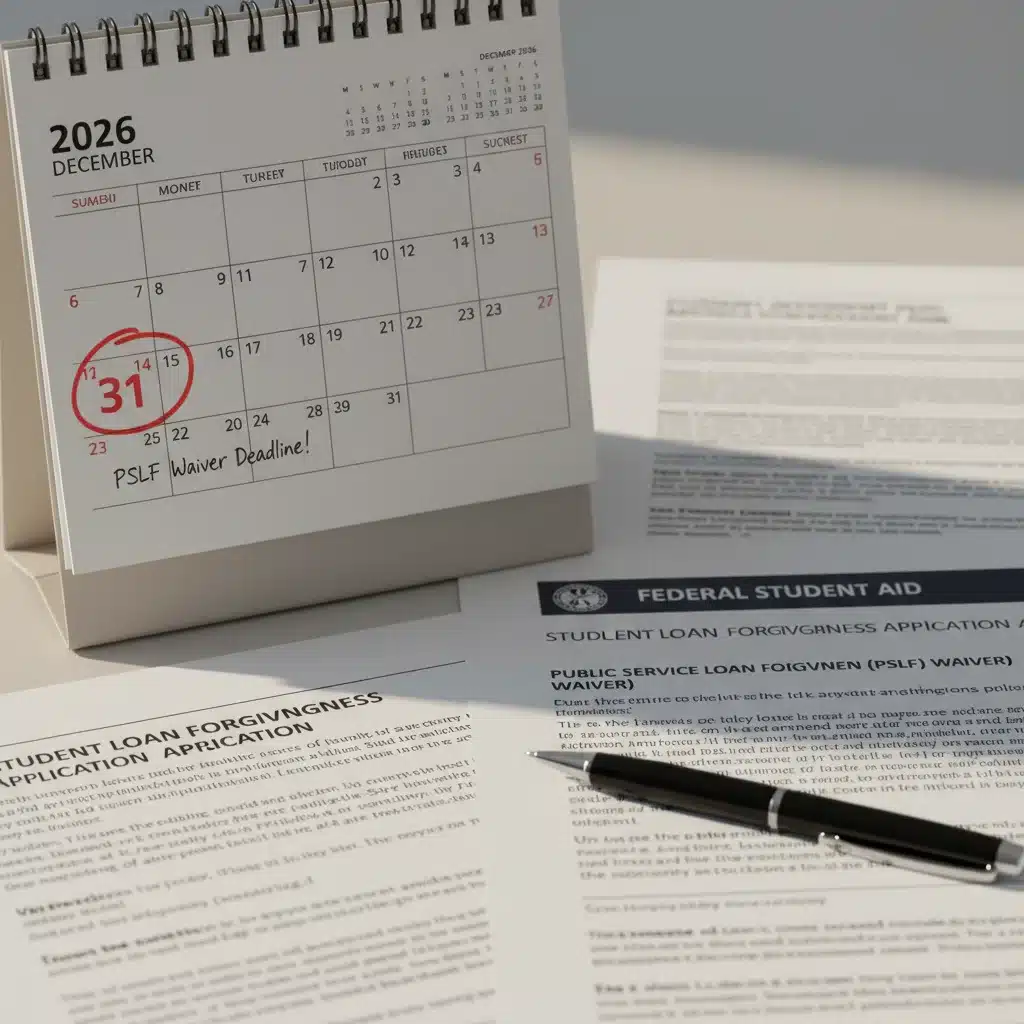
The opportunity presented by the PSLF Waiver, channeled through the IDR Account Adjustment, is an unprecedented chance for public service workers to significantly reduce or eliminate their student loan debt. The PSLF Waiver deadline of December 31, 2026, for consolidating non-Direct federal loans, is not merely a date on a calendar; it is a critical window of opportunity that could define your financial future.
For too long, dedicated public servants faced insurmountable obstacles in achieving the forgiveness they were promised. The reforms implemented by the Department of Education aim to correct these historical injustices. However, these benefits are not automatic for everyone, especially those with older loan types. Proactive steps are required.
Take the time now to investigate your loan types, certify all your qualifying employment, and if necessary, consolidate your loans before the PSLF Waiver deadline. Don’t let confusion or procrastination prevent you from accessing the forgiveness you’ve earned through your commitment to public service. This is your chance to maximize your student loan forgiveness and move forward with greater financial freedom. Act decisively, understand the requirements, and secure the relief you deserve.