2026 Estate Tax Exemption: Strategies to Preserve $13.61 Million

The 2026 estate tax exemption presents a critical window for high-net-worth individuals to implement strategies to preserve up to $13.61 million for their heirs, leveraging advanced planning techniques to minimize federal estate tax liabilities.
As 2026 approaches, many high-net-worth individuals are keenly focused on understanding and leveraging the federal estate tax exemption. With the current exemption set to revert to pre-2018 levels at the end of 2025, proactive planning around the 2026 estate tax exemption becomes paramount for those aiming to preserve significant wealth, potentially up to $13.61 million, for their heirs. This article delves into the practical solutions and strategic approaches essential for navigating this complex financial landscape.
understanding the 2026 estate tax exemption landscape
The federal estate tax landscape is dynamic, and 2026 marks a significant inflection point. The Tax Cuts and Jobs Act (TCJA) of 2017 dramatically increased the estate and gift tax exemption, effectively doubling it. However, this increase is temporary, and the exemption amount is scheduled to sunset on December 31, 2025. This means that starting January 1, 2026, the exemption is projected to revert to approximately $7 million per individual, adjusted for inflation, which is a substantial reduction from the anticipated $13.61 million for 2026 if the TCJA provisions were extended.
This impending change creates both urgency and opportunity for strategic planning. Understanding the exact figures and the mechanisms behind these adjustments is crucial. The IRS typically announces the official inflation-adjusted figures late in the preceding year, but projections allow for informed decision-making now. The core principle remains: any assets transferred above the exemption amount are subject to federal estate tax, currently at a top rate of 40%. Therefore, maximizing the use of the higher exemption before its potential reduction is a key objective for many.
the impact of the sunset provision
The sunset provision of the TCJA is not merely a technicality; it has profound implications for estate planning. Without Congressional action to extend the higher exemption, millions of dollars in wealth could become subject to estate taxes that would otherwise have been exempt. This necessitates a thorough review of existing estate plans and the consideration of new strategies to lock in the benefits of the current, higher exemption.
- Reduced Exemption: Expect a significant decrease in the individual estate and gift tax exemption, potentially halving the current amount.
- Increased Taxable Estates: More estates will likely fall into the taxable category, impacting a broader range of high-net-worth families.
- Planning Urgency: The window to utilize the higher exemption effectively closes at the end of 2025, making immediate action vital.
- State-Specific Considerations: While federal law changes, individual state estate and inheritance tax laws remain a separate layer of complexity.
In conclusion, the looming shift in the estate tax exemption demands immediate attention. Proactive engagement with financial and legal advisors is essential to assess personal circumstances and formulate a plan that capitalizes on the remaining period of higher exemptions, ensuring wealth preservation for future generations.
strategic gifting: leveraging the annual and lifetime exemptions
Gifting is a cornerstone of effective estate planning, particularly when navigating the 2026 estate tax exemption. There are two primary avenues for gifting: the annual gift tax exclusion and the lifetime gift tax exemption. Understanding how to utilize both strategically can significantly reduce the size of your taxable estate.
The annual gift tax exclusion allows you to give a certain amount to as many individuals as you wish each year, without incurring gift tax or using up any of your lifetime exemption. For 2025, this amount is projected to be around $18,000 per recipient. This is an extremely powerful tool for consistent, incremental wealth transfer, especially for families with multiple children and grandchildren. By consistently using annual exclusions, a substantial amount of wealth can be transferred tax-free over time.
maximizing lifetime exemption gifts before 2026
The lifetime gift tax exemption is the aggregate amount an individual can give away during their lifetime without paying gift tax. This is the same amount as the estate tax exemption. With the exemption potentially decreasing in 2026, making large gifts before December 31, 2025, is a critical strategy. The IRS has confirmed that there will be no “clawback” for gifts made under the higher exemption amount if the exemption later decreases. This provides a strong incentive to utilize as much of the current high exemption as possible.
- Irrevocable Gifting: Consider making irrevocable gifts to trusts or directly to heirs to remove assets from your estate permanently.
- Appreciating Assets: Prioritize gifting assets that are expected to appreciate significantly in value, as future appreciation will also be removed from your estate.
- Spousal Unification: Married couples can combine their exemptions, allowing for even larger tax-free transfers.
- Gift Tax Returns: Be diligent in filing gift tax returns (Form 709) for any gifts exceeding the annual exclusion, even if no tax is due, to properly track your lifetime exemption usage.
The strategic use of both annual and lifetime gifting opportunities before the end of 2025 can be instrumental in reducing your taxable estate and preserving wealth for your beneficiaries. Consulting with an estate planning attorney is vital to ensure these gifts are structured correctly and comply with all legal requirements.
the role of trusts in wealth preservation
Trusts are indispensable tools in sophisticated estate planning, offering flexibility and control over how assets are distributed, while also providing significant tax advantages. For those navigating the complexities of the 2026 estate tax exemption, various types of trusts can be employed to protect wealth from taxes and ensure it reaches intended beneficiaries.
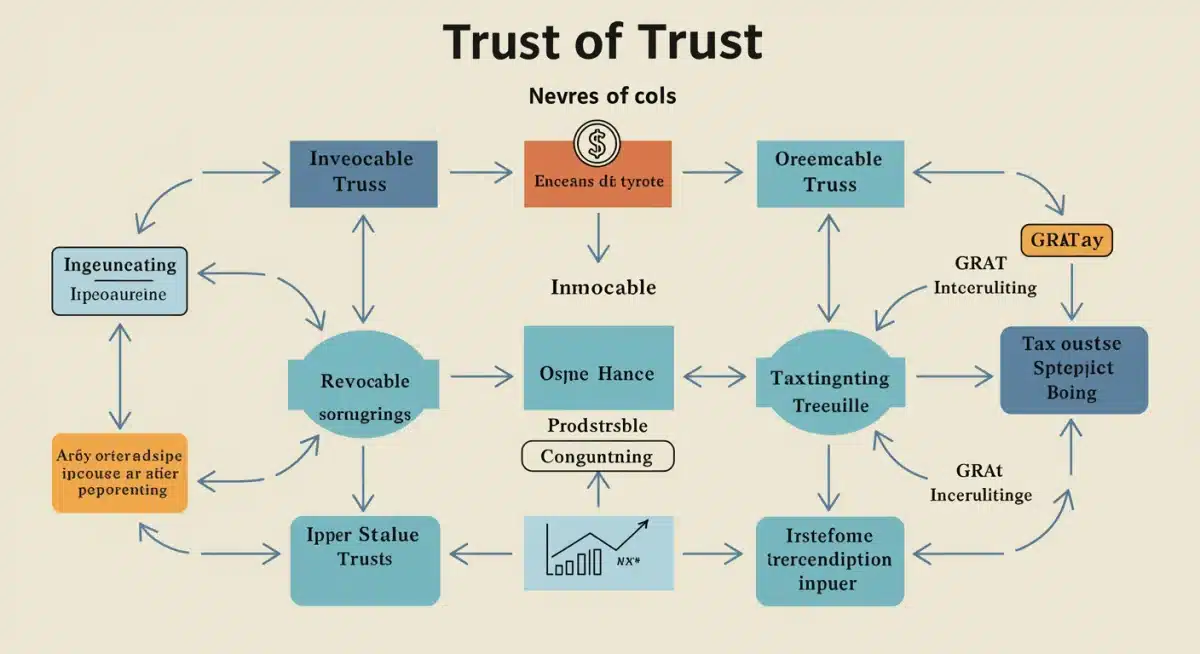
An irrevocable trust, once established, cannot be easily changed or revoked. This characteristic is precisely what makes them powerful for estate tax planning. Assets placed into an irrevocable trust are generally removed from your taxable estate, thus not subject to estate taxes upon your death. This is particularly relevant now, as transferring assets into such trusts before the exemption potentially decreases can effectively lock in the benefits of the higher current exemption.
types of trusts for optimal tax efficiency
Several types of irrevocable trusts are particularly effective for wealth preservation and minimizing estate taxes:
- Grantor Retained Annuity Trusts (GRATs): These trusts allow you to transfer appreciating assets out of your estate while retaining an income stream for a set period. Any appreciation above the IRS-determined interest rate passes to beneficiaries gift-tax free.
- Irrevocable Life Insurance Trusts (ILITs): An ILIT holds a life insurance policy, removing the death benefit from your taxable estate. This can provide liquidity to your heirs to pay estate taxes without those funds themselves being taxed.
- Dynasty Trusts (Generation-Skipping Trusts): Designed to last for generations, these trusts can bypass estate taxes in multiple generations, preserving wealth for distant descendants. They are particularly useful for utilizing the generation-skipping transfer (GST) tax exemption.
- Charitable Remainder Trusts (CRTs): While primarily charitable, CRTs can provide an income stream to you for a period, with the remainder going to charity. This can reduce your taxable estate and provide an income tax deduction.
Each trust type serves a specific purpose, and the optimal choice depends on individual financial goals, family dynamics, and the nature of the assets. The strategic use of trusts before the 2026 exemption changes can secure significant tax savings and provide long-term financial security for your heirs.
charitable giving strategies for tax benefits
Charitable giving is not only a philanthropic endeavor but also a sophisticated estate planning strategy that can significantly reduce estate tax liabilities, especially relevant as we approach the 2026 estate tax exemption adjustments. By integrating charitable contributions into your estate plan, you can support causes you care about while simultaneously minimizing the taxable size of your estate.
One of the most straightforward ways to achieve this is through outright gifts to qualified charities. These gifts, whether made during your lifetime or at death, are generally fully deductible for estate tax purposes, effectively removing the donated assets from your taxable estate. For high-net-worth individuals, this can translate into substantial tax savings, particularly for large estates that would otherwise face significant federal estate tax obligations.
advanced charitable vehicles
Beyond simple outright gifts, several advanced charitable giving vehicles offer enhanced benefits and flexibility:
- Charitable Remainder Trusts (CRTs): As mentioned previously, CRTs allow you to donate assets to a trust, receive income for life or a specified term, and then have the remainder go to charity. This provides an immediate income tax deduction and removes the assets from your taxable estate.
- Charitable Lead Trusts (CLTs): The inverse of a CRT, a CLT provides income to a charity for a period, after which the remaining assets revert to your non-charitable beneficiaries. This can be an excellent way to reduce gift or estate taxes on assets passed to heirs while supporting a charity.
- Donor-Advised Funds (DAFs): DAFs offer flexibility and immediate tax deductions. You contribute assets to a fund sponsored by a public charity, receive an immediate tax deduction, and then recommend grants to charities over time. The assets are removed from your estate upon contribution.
- Private Foundations: For those with significant philanthropic goals and substantial wealth, a private foundation offers maximum control over charitable giving, though it comes with more administrative complexity. Assets transferred to a private foundation are removed from your taxable estate.
Integrating charitable giving into your estate plan requires careful consideration of your financial situation and philanthropic objectives. These strategies not only provide significant tax benefits but also create a lasting legacy of giving. Consulting with both a financial advisor and an estate planning attorney is crucial to ensure these vehicles are properly structured and aligned with your overall wealth preservation goals.
revisiting beneficiary designations and ownership structures
Often overlooked in comprehensive estate planning, beneficiary designations and asset ownership structures play a critical role in how assets are transferred and whether they are subject to estate taxes. As we prepare for potential changes to the 2026 estate tax exemption, it’s imperative to review and potentially revise these arrangements to ensure they align with your wealth preservation objectives.
Many assets, such as retirement accounts (IRAs, 401(k)s), life insurance policies, and annuities, pass directly to named beneficiaries outside of the probate process. This means they are not distributed according to your will. While this can simplify transfer, it’s crucial to ensure these designations are up-to-date and reflect your current wishes. An outdated beneficiary designation could lead to unintended consequences, including assets going to an ex-spouse or to an individual who may not be equipped to manage a large inheritance.
optimizing ownership for tax efficiency
The way assets are titled also has significant estate tax implications:
- Joint Tenancy with Right of Survivorship (JTWROS): Assets held in JTWROS pass automatically to the surviving owner. While convenient, the full value of the asset may be included in the deceased’s estate for tax purposes, depending on who contributed to its purchase.
- Tenancy by the Entirety: Similar to JTWROS but exclusively for married couples, offering creditor protection in some states. Estate tax implications are similar to JTWROS.
- Tenancy in Common: Each owner holds a distinct, undivided share, which can be passed on through their will. This allows for more granular control over inheritance but doesn’t avoid probate.
- Community Property: In community property states, assets acquired during marriage are owned equally by both spouses. Upon the death of one spouse, their half of the community property receives a stepped-up basis, which can be beneficial for capital gains tax purposes.
Beyond these, consider the ownership of business interests. Family limited partnerships (FLPs) and limited liability companies (LLCs) can provide mechanisms for transferring business assets to future generations with potential valuation discounts for gift and estate tax purposes. Regularly reviewing and adjusting beneficiary designations and asset ownership structures is a fundamental step in optimizing your estate plan. These details, though seemingly minor, can have a substantial impact on the tax efficiency of your wealth transfer strategy.
the importance of professional guidance and ongoing review
Navigating the intricacies of the 2026 estate tax exemption and implementing effective wealth preservation strategies is a complex undertaking that rarely succeeds without expert guidance. The legal, financial, and tax landscapes are constantly evolving, and what might be an optimal strategy today could require adjustment tomorrow. Therefore, engaging a team of experienced professionals and committing to ongoing review are paramount.
An estate planning attorney is crucial for drafting legally sound documents, such as wills, trusts, and powers of attorney, ensuring they comply with current laws and effectively achieve your objectives. A financial advisor plays a key role in analyzing your assets, projecting future growth, and recommending investment strategies that align with your estate plan. A tax advisor or CPA will help you understand the tax implications of various strategies and ensure compliance with all federal and state tax regulations.
assembling your expert team and regular reviews
Building a cohesive team of advisors who communicate effectively is essential. Each professional brings a unique perspective and expertise, and their collaborative efforts can lead to a more robust and comprehensive estate plan. This collaborative approach helps identify potential pitfalls and opportunities that might be missed by working with individual advisors in isolation.
- Estate Planning Attorney: Focuses on legal structures, document drafting, and compliance.
- Financial Advisor: Manages investments, provides wealth projections, and advises on financial strategies.
- Tax Advisor/CPA: Ensures tax efficiency, compliance, and advises on tax implications of gifting and trust structures.
- Insurance Professional: Helps integrate life insurance into the estate plan for liquidity and wealth replacement.
Moreover, estate planning is not a one-time event; it requires continuous monitoring and adjustment. Life events such as births, deaths, marriages, divorces, or significant changes in wealth can all necessitate revisions to your plan. Similarly, legislative changes, like the impending 2026 estate tax exemption adjustment, demand a review to ensure your plan remains effective and aligned with your goals. Regular meetings with your advisory team, ideally annually or whenever significant life or legislative changes occur, are critical to maintaining an optimized estate plan.
preparing for legislative uncertainty and future adjustments
The discussion around the 2026 estate tax exemption is inherently tied to legislative uncertainty. While the TCJA’s sunset provision is currently scheduled, there’s always the possibility of Congressional action that could alter these predictions. This legislative fluidity means that flexibility and adaptability must be core tenets of any robust estate plan. Waiting until the last minute to see how Congress acts is a risky strategy that could lead to missed opportunities.
Instead, a proactive approach involves scenario planning. What if the exemption remains high? What if it reverts as planned? What if it’s reduced even further? By considering these possibilities, you and your advisors can develop a plan with contingencies that can be quickly implemented depending on the legislative outcome. This might involve initiating strategies now that lock in the current benefits, while also having a parallel plan ready for a different legislative environment.
adapting your plan to a changing landscape
Key considerations for adapting to future adjustments include:
- Portability Election: For married couples, the portability election allows a surviving spouse to use any unused portion of their deceased spouse’s federal estate tax exemption. This is a crucial safety net even if exemptions change, but it must be elected on a timely filed estate tax return (Form 706).
- Formula-Based Clauses: Ensure your will and trust documents include formula-based clauses that automatically adjust distributions based on the applicable exemption amounts at the time of your death. This prevents your plan from becoming outdated due to legislative changes.
- State Estate Taxes: Remember that federal changes do not impact state estate or inheritance taxes. If you reside in a state with its own estate tax, those considerations remain constant and must be factored into your planning, irrespective of federal law.
- Understanding Basis Planning: With potential changes in exemptions, understanding how assets receive a stepped-up basis at death becomes even more critical for heirs to minimize capital gains taxes.
Ultimately, preparing for legislative uncertainty means building an estate plan that is resilient and flexible. It involves making informed decisions based on current law while being ready to pivot as new legislation emerges. Regular consultation with your professional team is indispensable in this ongoing process, ensuring your wealth preservation strategies remain effective regardless of future legislative actions.
| Key Strategy | Brief Description |
|---|---|
| Strategic Gifting | Utilize annual and lifetime gift tax exemptions before 2026 to reduce taxable estate size. |
| Leveraging Trusts | Employ irrevocable trusts (GRATs, ILITs) to remove assets from your taxable estate. |
| Charitable Planning | Integrate charitable vehicles like CRTs or DAFs to reduce estate taxes and support causes. |
| Professional Guidance | Engage estate attorneys, financial, and tax advisors for comprehensive, ongoing planning. |
frequently asked questions about the 2026 estate tax exemption
For 2025, the federal estate tax exemption is projected to be around $13.61 million per individual. This amount is subject to annual inflation adjustments and is scheduled to decrease significantly in 2026.
The exemption is scheduled to revert to approximately $7 million per individual, adjusted for inflation, due to the sunset provision of the 2017 Tax Cuts and Jobs Act, unless Congress acts to extend the current higher limits.
The IRS has confirmed that there will be no “clawback” for gifts made under the higher exemption amount if the exemption later decreases. This policy allows individuals to utilize the current high exemption without fear of future taxation.
Key strategies include making large lifetime gifts, establishing irrevocable trusts (like GRATs or ILITs), and incorporating charitable giving vehicles to remove assets from your taxable estate before the exemption potentially shrinks.
No, federal changes to the estate tax exemption do not directly impact state estate or inheritance tax laws. These are separate taxes levied by individual states, and their rules must be considered independently in your estate planning.
conclusion
The imminent shift in the 2026 estate tax exemption presents a critical but finite opportunity for high-net-worth individuals to secure their legacy and minimize tax burdens on their heirs. By understanding the scheduled changes and proactively implementing strategies like strategic gifting, leveraging various trusts, and integrating charitable giving, significant wealth can be preserved. The window to utilize the current, higher exemption is closing, making timely and informed action paramount. Engaging a team of experienced financial, legal, and tax advisors for comprehensive planning and ongoing review is not just advisable but essential to navigate this complex landscape successfully and ensure your estate plan remains robust and effective, regardless of future legislative developments.